E7018 Welding Rod: Amperage Chart, Settings & When to Use
The go-to stick rod for strong, clean welds on structural steel. Runs 70 to 400 amps on DCEP or AC, rated for flat, horizontal, vertical up, overhead. Amperage chart by diameter below.
E7018 is the most widely used structural welding rod. It has a low-hydrogen coating that prevents cracking and produces smooth, strong welds you can trust on load-bearing joints. If a welding code or blueprint calls out a specific rod, it is usually this one. The "70" means 70,000 psi tensile strength, and the "18" tells you it is a low-hydrogen iron powder rod that runs on DCEP or AC.
What This Means in Practice
If a structural drawing calls out a welding rod, it is almost always E7018. The low-hydrogen coating means your welds will not crack on thick steel or in cold weather. The trade-off is storage: you need a rod oven. If you do not have one, your welds will have porosity on anything that matters. For non-critical shop work without an oven, consider E7014 instead.
What Amps for E7018?
| Diameter | Amperage Range |
|---|---|
| 3/32" (2.4 mm) | 70 - 100A |
| 1/8" (3.2 mm) | 90 - 160A |
| 5/32" (4 mm) | 130 - 200A |
| 3/16" (4.8 mm) | 200 - 280A |
| 7/32" (5.6 mm) | 260 - 340A |
| 1/4" (6.4 mm) | 300 - 400A |
Amperage by Individual Diameter
3/32 E7018 Amperage
Set 3/32 E7018 to 70 - 100 amps. Run DCEP or AC. This is the smallest available size. Best for vertical-up and overhead where you need a small, controllable puddle. Start around 85A.
1/8 E7018 Amperage
Set 1/8 E7018 to 90 - 160 amps. Run DCEP or AC. This is the most commonly used E7018 size. Start at 125A for flat work, drop to 90-113A for vertical-up.
5/32 E7018 Amperage
Set 5/32 E7018 to 130 - 200 amps. Run DCEP or AC. A good choice when you need control. Run 130-165A for out-of-position work.
3/16 E7018 Amperage
Set 3/16 E7018 to 200 - 280 amps. Run DCEP or AC. Production size for flat work. If spatter increases above 252A, check your arc length.
7/32 E7018 Amperage
Set 7/32 E7018 to 260 - 340 amps. Run DCEP or AC. Built for flat and horizontal production. Back off 10-15A from 340 if the bead crowns.
1/4 E7018 Amperage
Set 1/4 E7018 to 300 - 400 amps. Run DCEP or AC. Largest available diameter. High deposition for flat and horizontal fillet welds on thick plate. Requires 300A minimum to run properly.
E7018 Suitability Scores
How well this electrode matches common applications. Not a quality rating. all AWS-certified electrodes meet their specification.
What Is E7018 Good For?
Structural steel, buildings, bridges, beams.
Pressure vessels and boilers.
Pipe fill and cap passes after a 6010 root.
Any joint that needs to pass inspection or X-ray.
Welding in cold conditions where cracking is a concern.
Thick plate where hydrogen cracking is a risk.
Where E7018 Falls Short
Must be kept dry, store opened rods in a rod oven at 250-300F or they absorb moisture and your welds will have porosity.
Cannot run vertical-down.
Needs clean, dry steel to work properly, not the rod for rusty field repairs (use E6010 or E6011 for that).
Slag can be stubborn in tight corners.
E7018 Under the Hood
The Arc
Smooth, quiet arc with a steady hum. No popping, no digging. The arc cushion from the iron powder coating keeps the puddle calm. Sounds like a low rumble, not a crackle.
Technique
Drag technique. Keep the rod at 5-15 degrees from vertical, push into the joint. No whipping on flat or horizontal. For vertical-up, use a slight pause at each toe of a triangular weave to tie in the edges and prevent undercut.
The Puddle
Large, slow-moving puddle with complete slag coverage. The slag is heavy, glassy, and self-peeling. It lifts off the bead in one piece on a good weld. The finished bead is flat to slightly convex with fine, uniform ripples.
When It Goes Wrong
If the slag traps in the weld, you are moving too fast or your angle is wrong. The slag should flow behind the puddle, not into it. If the bead undercuts at the toes on vertical, pause longer at each side before crossing.
Which Size E7018 to Use
| Rod Diameter | Material Thickness | Application |
|---|---|---|
| 3/32" | 1/8" to 3/16" | Thin plate and out-of-position fills |
| 1/8" | 3/16" to 3/8" | Standard structural fill and cap passes |
| 5/32" | 3/8" to 3/4" | Heavy structural plate, multi-pass joints |
Shop Talk
E7018 is the rod that structural inspectors want to see. When a weld has to pass visual, bend test, and X-ray, this is what you run. Every certified welder takes their test on 7018. The catch: moisture kills it. A 7018 rod left out overnight absorbs enough water to put hydrogen cracks in your weld that do not show up for 48 hours. Pull rods from the oven, weld with them within 4 hours, and put unused rods back. This is not optional on code work.
Bottom Line
E7018 earns its keep on structural jobs. It has no business on repair applications. The closest alternative is E6010.
Setup & Safety Reference
How to Store E7018
Low-hydrogen electrode. Moisture control is critical.
Oven Holding Temperature: 250-300°F
Max Atmosphere Exposure: 4 hours before rebaking required
Rebake Temperature: 500-800°F for 1-2 hours
Critical: low-hydrogen electrode. After opening, store in rod oven at 250-300F. If exposed to atmosphere more than 4 hours, rebake at 500-800F for 1-2 hours per AWS A5.1:2025. Maximum 3 rebakes.
Preheat & Interpass Temperature for E7018
Preheat varies by base metal thickness. Low-hydrogen processes require less preheat than non-low-hydrogen.
| Base Metal Thickness | Minimum Preheat (°F) |
|---|---|
| up to 3/4" | Not required |
| 3/4" to 1-1/2" | 50°F |
| 1-1/2" to 2-1/2" | 150°F |
| over 2-1/2" | 225°F |
Maximum interpass temperature: 600°F
Source: AWS D1.1 Table 3.2, Category B (low-hydrogen)
Fume Generation
Rating: Medium-Low
Typical fume rate: 0.3-0.6 g/min
Low-hydrogen coating produces less fume than cellulose or titania types.
Common Brand Names for E7018
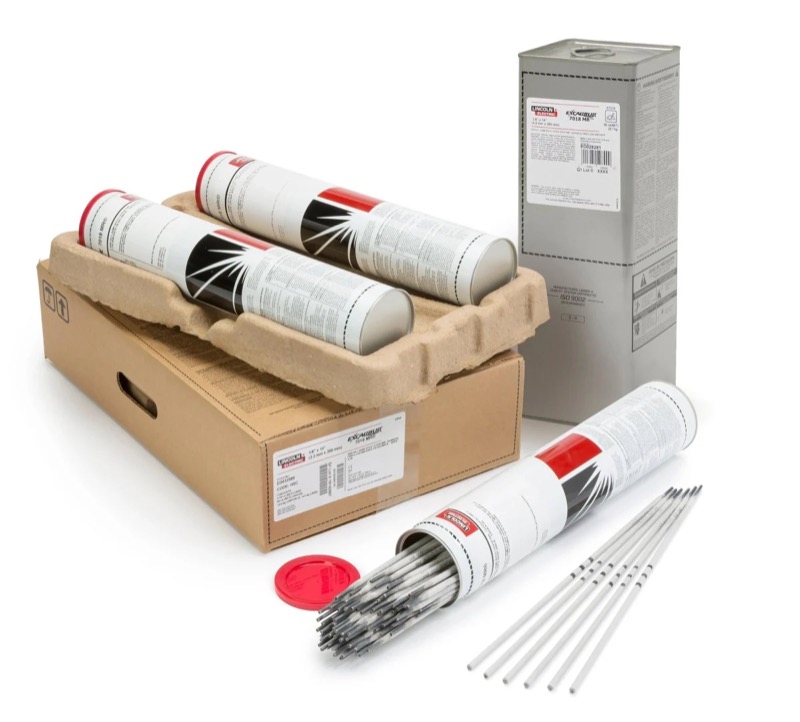
Lincoln Electric Excalibur 7018 MR is the most common E7018 on the shelf. 4 other manufacturers make the same classification.
| Manufacturer | Product Name | Notes |
|---|---|---|
| Lincoln Electric | Excalibur 7018 MR | Moisture-resistant hermetically sealed |
| Lincoln Electric | Jetweld LH-78MR | |
| Hobart | Hobart 718MC | |
| ESAB | Atom Arc 7018 | |
| Forney | E7018 |
Full Specs
| Property | Value |
|---|---|
| AWS Classification | E7018 |
| Process | Stick Welding (SMAW) |
| Polarity | DCEP, AC |
| Positions | flat, horizontal, vertical up, overhead |
| Penetration | medium |
| Coating Type | low-hydrogen iron powder |
| Tensile Strength | 70,000 psi |
| Yield Strength | 58,000 psi |
| Elongation | 22% |
| Impact Toughness | 20 ft-lbs at -20°F |
| Base Metals | carbon steel, low-alloy steel, high-strength low-alloy steel |
| Shielding Gas | Flux-shielded (no external gas) |
| Max Interpass Temp | 600°F |
| AWS Specification | AWS A5.1/A5.1M:2012 |
Common Questions About E7018
Can I run E7018 on an AC welder?
Yes, but it depends on the machine. Standard E7018 needs at least 70-80V open circuit voltage to hold an arc on AC. Most industrial AC/DC machines can handle it. Smaller buzz box welders (like the Lincoln AC-225) can struggle with standard E7018, the arc will sputter and be hard to restart. If you have a smaller AC-only machine, buy E7018AC rods. They have a modified flux that arc-starts easier on low-OCV machines. For code or structural work, always run E7018 on DCEP. If you only have a buzz box and need an easy-running all-position rod, E6011 is a better fit for AC. See also: E6013 vs E7018 comparison.
Do I need a rod oven for E7018?
For code work, yes. E7018 is a low-hydrogen rod and its coating absorbs moisture from the air. Wet rods cause porosity and hydrogen cracking. After you open a sealed container, rods should go into an oven at 250-300F. If they have been out in the air more than 4 hours, recondition them at 700-800F for one hour before use. For non-critical farm and shop repairs, many welders get by with keeping opened rods in a sealed plastic container, but the welds will not meet code.
What happens if E7018 rods get wet?
Moisture in the flux coating releases hydrogen into the weld pool. This causes two problems: porosity (gas pockets trapped in the weld) and hydrogen-induced cracking, which can happen hours or days after welding. On thick or high-strength steel, hydrogen cracking can cause a weld to fail with no warning. If your rods have been exposed to humidity or rain, recondition them in an oven at 700-800F for one hour. If the coating is visibly damaged or flaking, discard them.
What amperage for 1/8 inch E7018?
Start at 110-160A for 1/8 inch (3.2 mm) E7018. Use the lower end (110-125A) for vertical-up and overhead. Use the higher end (140-160A) for flat and horizontal fillets. If the rod is sticking or the bead is piling up, increase amperage 5-10A. If you are burning through or getting excessive spatter, reduce. These are starting points, adjust based on fit-up, material thickness, and your machine.
Is E7018 good for beginners?
E7018 is one of the easier rods to run once you have basic arc control. It has a smooth, quiet arc, low spatter, and the slag peels off cleanly. However, it is not the best rod to learn on because it is sensitive to moisture and requires proper storage. Most instructors start students on E6013 for basic technique, then move to E7018 for structural practice. If you are learning in a school or shop with a rod oven, E7018 is fine to start with. E6013 specifications, the easier rod most instructors recommend for beginners. See also: E6013 vs E7018 comparison.
Where to Buy E7018
As an Amazon Associate, GageRef earns from qualifying purchases. These are affiliate links.
Manufacturer Data Sheets
External links to standards bodies and manufacturers. These leave GageRef.
Reference data only. Verify all settings against manufacturer documentation and the applicable welding code before use. Amperage ranges are starting points that vary by position, fit-up, and material. Welding involves serious injury risks including burns, electric shock, fume exposure, and fire. This site does not replace proper training, certification, or employer safety procedures. See full terms of use.
Data sourced from AWS A5.1/A5.1M. Amperage ranges are approximate starting points. adjust based on position, fit-up, and material thickness. Always follow manufacturer recommendations and applicable codes.