E7016 vs E7018: Which Low-Hydrogen Rod for Your Welder?
Both are 70 ksi low-hydrogen rods for code-quality structural welds. E7016 runs on AC without high open-circuit voltage. E7018 has iron powder in the flux for higher deposition but typically needs DC or a high-OCV AC machine.
E7016: You have an AC-only welder (buzz box) and need code-quality low-hydrogen welds. E7018: You have a DC welder or high-OCV AC machine.
Which One Should You Use?
Pick E7016 if:
You have an AC-only welder (buzz box) and need code-quality low-hydrogen welds. Small shops and field work where only AC is available.
Runs on AC, DCEP, 55-300A range. E7016 full amperage chart
Pick E7018 if:
You have a DC welder or high-OCV AC machine. Production structural fabrication where deposition rate matters. E7018 is more commonly stocked and specified in welding procedures.
Runs on DCEP, AC, 70-400A range. E7018 full amperage chart
Key Differences
| Attribute | E7016 | E7018 |
|---|---|---|
| Flux Composition | Low-hydrogen potassium flux; the original low-H rod design | Low-hydrogen iron powder flux; higher deposition rate, thicker slag |
| Polarity / Power Source | Runs on AC or DCEP, including low-OCV AC welders | AC or DCEP, but AC requires 70+ OCV to maintain a stable arc |
| Deposition Rate | Lower deposition; less iron powder in the coating | 10-15% higher deposition due to iron powder flux |
| Industry Usage | Niche use where only AC welders are available | Industry standard low-hydrogen rod; specified in most WPS documents |
Settings at a Glance
Machine settings and operating characteristics side by side. For full amperage charts, see the individual electrode pages.
| Setting | E7016 | E7018 |
|---|---|---|
| Polarity | AC, DCEP | DCEP, AC |
| Positions | flat, horizontal, vertical-up, overhead | flat, horizontal, vertical-up, overhead |
| Penetration | medium | medium |
| Coating | low hydrogen potassium | low-hydrogen iron powder |
| Amps at 3/32" | 55-90A | 70-100A |
| Amps at 1/8" | 80-130A | 90-160A |
| Amps at 5/32" | 110-170A | 130-200A |
How E7016 and E7018 Work Together
E7018 is specified far more often in welding procedure specifications (WPS). If a WPS calls for E7018, you cannot substitute E7016 without re-qualifying the procedure. However, if you need the same mechanical properties on an AC machine, E7016 is the direct answer.
Common Mistake With E7016
Assuming E7018 runs on any AC machine. Many small AC welders do not have enough open-circuit voltage to strike and maintain a stable E7018 arc. E7016 solves this problem.
Practical Differences
| Factor | E7016 | E7018 |
|---|---|---|
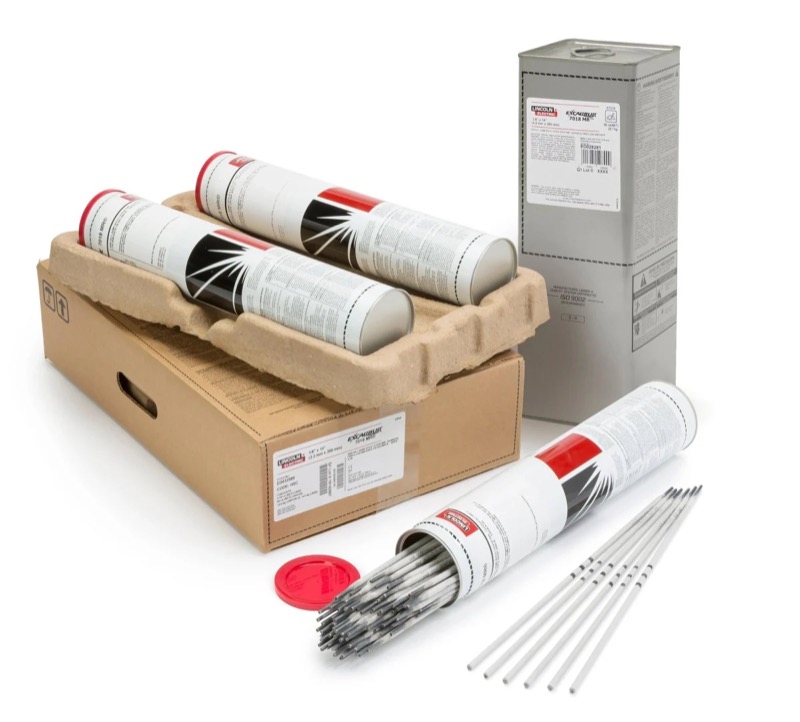
| Common Brands | Jetweld LH-75, Atom Arc 7016 | Excalibur 7018 MR, Jetweld LH-78MR |
Where to Buy
As an Amazon Associate, GageRef earns from qualifying purchases. These are affiliate links.
E7016 vs E7018: Common Questions
Which is better, E7016 or E7018?
One is not a replacement for the other. Key differences: Flux Composition: E7016 has low-hydrogen potassium flux; the original low-h rod design, while E7018 has low-hydrogen iron powder flux; higher deposition rate, thicker slag. Polarity / Power Source: E7016 has runs on ac or dcep, including low-ocv ac welders, while E7018 has ac or dcep, but ac requires 70+ ocv to maintain a stable arc. Deposition Rate: E7016 has lower deposition; less iron powder in the coating, while E7018 has 10-15% higher deposition due to iron powder flux. Start with what machine you have and what condition the steel is in.
Can I substitute E7016 for E7018?
Check the WPS or code first. E7016 runs on AC/DCEP, E7018 on DCEP/AC. Your machine decides. Coating chemistry is different (low hydrogen potassium vs low-hydrogen iron powder), so the arc and slag behave differently.
Can I use both E7016 and E7018 on the same joint?
E7018 is specified far more often in welding procedure specifications (WPS). If a WPS calls for E7018, you cannot substitute E7016 without re-qualifying the procedure. However, if you need the same mechanical properties on an AC machine, E7016 is the direct answer.
Reference data only. Verify all settings against manufacturer documentation and the applicable welding code before use. Amperage ranges are starting points that vary by position, fit-up, and material. Welding involves serious injury risks including burns, electric shock, fume exposure, and fire. This site does not replace proper training, certification, or employer safety procedures. See full terms of use.
Data sourced from AWS A5.1.