E6010 Welding Rod: Amperage, Settings & Pipe Welding Guide
Deep-penetrating pipe welding rod. Runs 40 to 320 amps on DCEP, rated for flat, horizontal, vertical up, vertical down, overhead. Amperage chart by diameter below.
E6010 is the standard rod for pipeline root passes. It has an aggressive, digging arc that blows through rust, mill scale, and dirty steel to get full penetration. The slag is thin and almost nonexistent, so cleanup is fast. If you are welding pipe or doing field repairs where the steel is not clean, this is the rod to reach for. It runs on DC positive (DCEP) only, it will not work on an AC buzz box.
What This Means in Practice
E6010 is not a rod you learn on. It is a rod you earn. The arc is violent, the puddle freezes fast, and controlling it through a root opening on pipe takes hundreds of hours of practice. But nothing else burns through rust, mill scale, and bad fit-up the way 6010 does. Pipeline welders live on this rod.
What Amps for E6010?
| Diameter | Amperage Range |
|---|---|
| 3/32" (2.4 mm) | 40 - 80A |
| 1/8" (3.2 mm) | 75 - 130A |
| 5/32" (4 mm) | 100 - 180A |
| 3/16" (4.8 mm) | 140 - 225A |
| 7/32" (5.6 mm) | 170 - 250A |
| 1/4" (6.4 mm) | 210 - 320A |
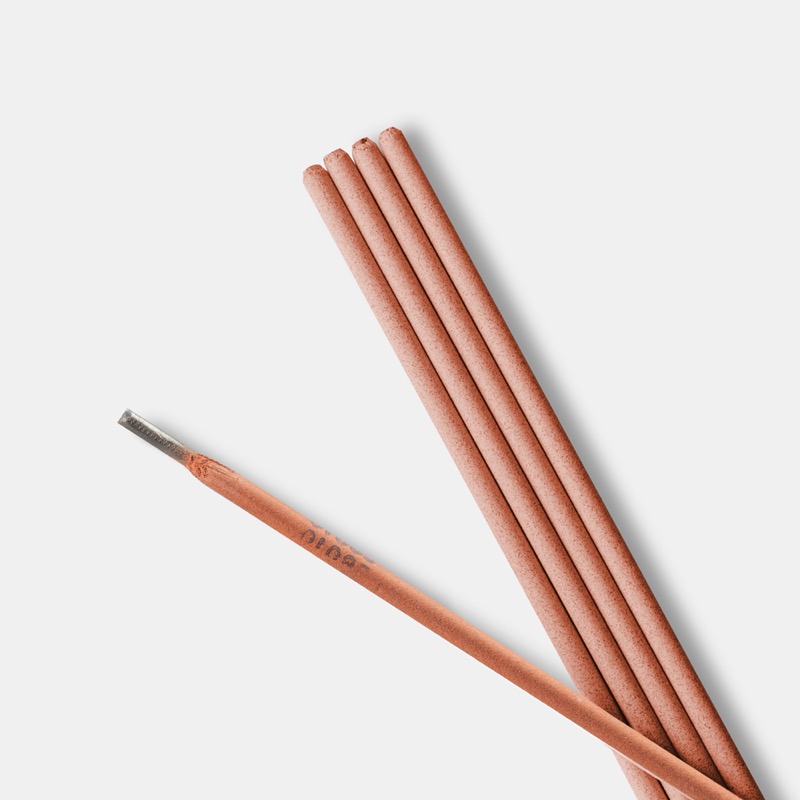
Amperage by Individual Diameter
3/32 E6010 Amperage
Set 3/32 E6010 to 40 - 80 amps. Run DCEP. This is the smallest available size. Best for vertical-up and overhead where you need a small, controllable puddle. Start around 60A.
1/8 E6010 Amperage
Set 1/8 E6010 to 75 - 130 amps. Run DCEP. This is the most commonly used E6010 size. Start at 103A for flat work, drop to 75-93A for vertical-up.
5/32 E6010 Amperage
Set 5/32 E6010 to 100 - 180 amps. Run DCEP. Sized for vertical and overhead joints. Stay in the 100-140A range and keep the puddle small.
3/16 E6010 Amperage
Set 3/16 E6010 to 140 - 225 amps. Run DCEP. Built for flat and horizontal production. Back off 10-15A from 225 if the bead crowns.
7/32 E6010 Amperage
Set 7/32 E6010 to 170 - 250 amps. Run DCEP. High fill rate in flat position. Drop 10-15A if you see undercut at the toes.
1/4 E6010 Amperage
Set 1/4 E6010 to 210 - 320 amps. Run DCEP. Largest diameter. Maximum penetration and deposition in flat and horizontal position. This size requires a machine that can deliver 320A sustained.
E6010 Suitability Scores
How well this electrode matches common applications. Not a quality rating. all AWS-certified electrodes meet their specification.
What Is E6010 Good For?
Pipe root passes where you need full penetration through the back side.
Field repairs on rusty, painted, or dirty steel.
Vertical-down welding on pipe.
Cutting or gouging in an emergency (crank the amps up).
Any situation where the steel is not clean and you need the arc to burn through it.
Where E6010 Falls Short
DCEP only, will not run on an AC welder.
Rough bead with coarse ripples, not pretty.
High hydrogen content means it can cause cracking on thick, high-strength steel without preheat.
Takes real skill to control the aggressive arc.
Not the rod for clean shop work where appearance matters.
E6010 Under the Hood
Arc Behavior
Violent, snapping arc with a tight cone. Sounds like a jackhammer hitting concrete. The arc digs into the base metal and throws small sparks straight back at you.
How to Move
Whip and pause. Push the rod forward 1/8 inch, pause to let the puddle fill, whip forward again. On pipe roots, keep a tight keyhole ahead of the puddle and watch the back side fill through it.
What the Puddle Does
Small, fast-freezing puddle with almost no slag cover. The molten pool solidifies within a second of moving past. You can see the ripples freeze behind you in real time.
Troubleshooting
If the rod sticks, you are too close. If the arc wanders and spatters everywhere, you are too far. Find the sweet spot where the snap is steady and the puddle stays the size of a dime.
Which Size E6010 to Use
| Rod Diameter | Material Thickness | Application |
|---|---|---|
| 3/32" | 1/16" to 1/8" | Sheet metal tacks and thin-wall pipe roots |
| 1/8" | 1/8" to 3/8" | Standard pipe root passes and field repairs |
| 5/32" | 3/8" to 1/2" | Heavier structural root passes |
Shop Talk
E6010 is the rod that separates pipeline welders from everyone else. You cannot fake it with this rod. The arc punishes hesitation and rewards commitment. Pipe welders who run 6010 roots all day develop a rhythm you can hear across the shop. If you are learning pipe, you will burn through 50 pounds of 6010 before your roots start passing X-ray. Keep your hood tight. The cellulose coating throws UV hard enough to burn exposed skin at close range.
Bottom Line
Use E6010 for pipe work. Skip it for beginner. Need something different? Look at E6011.
Setup & Safety Reference
How to Store E6010
Store at room temperature in dry area. Do NOT bake. Cellulose coating requires 3-7% moisture to function. Baking destroys electrode.
Preheat & Interpass Temperature for E6010
Preheat varies by base metal thickness. Non-low-hydrogen electrodes require higher preheat on thick material.
| Base Metal Thickness | Minimum Preheat (°F) |
|---|---|
| up to 3/4" | Not required |
| 3/4" to 1-1/2" | 150°F |
| 1-1/2" to 2-1/2" | 225°F |
| over 2-1/2" | 300°F |
Maximum interpass temperature: 600°F
Source: AWS D1.1 Table 3.2, Category A (non-low-hydrogen)
Fume Generation
Rating: High
Typical fume rate: 0.8-1.5 g/min
Cellulose coating produces heavy fume. Use adequate ventilation or forced-air extraction.
Common Brand Names for E6010
4 manufacturers sell an E6010 product. Lincoln Electric Fleetweld 5P+ is the one most shops stock.
| Manufacturer | Product Name | Notes |
|---|---|---|
| Lincoln Electric | Fleetweld 5P+ | Industry standard for pipeline root passes |
| Hobart | Hobart 610 | |
| ESAB | Sureweld 6010 | |
| Forney | E6010 |
Full Specs
| Property | Value |
|---|---|
| AWS Classification | E6010 |
| Process | Stick Welding (SMAW) |
| Polarity | DCEP |
| Positions | flat, horizontal, vertical up, vertical down, overhead |
| Penetration | deep |
| Coating Type | high cellulose sodium |
| Tensile Strength | 60,000 psi |
| Yield Strength | 48,000 psi |
| Elongation | 22% |
| Impact Toughness | 20 ft-lbs at -20°F |
| Base Metals | carbon steel, low-carbon steel |
| Shielding Gas | Flux-shielded (no external gas) |
| Max Interpass Temp | 600°F |
| AWS Specification | AWS A5.1/A5.1M:2012 |
E6010 Questions
What welding rod works on rusty steel?
E6010 or E6011. Both have a high-cellulose coating that produces an aggressive, digging arc capable of burning through rust, mill scale, paint, and light oil. E6010 requires DCEP only. E6011 runs on AC or DC, making it the better choice if you have an AC-only machine. For heavily corroded steel, grind the worst areas and clamp your ground lead to bare metal within 12-24 inches of the joint. No rod works well with a bad ground connection. See also: E6011 specifications, E6010 vs E6011 comparison.
Can E6010 run on AC?
No. E6010 has a high-cellulose sodium coating that requires DC positive (DCEP) to maintain the arc. It will not run on an AC machine. If you need the same deep penetration and fast-freeze characteristics on AC, use E6011 instead. E6011 has a high-cellulose potassium coating designed to stabilize the arc on AC while delivering similar performance. E6011 specifications, the AC-capable version of E6010. See also: E6010 vs E6011 comparison.
Why is E6010 used for pipe welding?
E6010 is the standard rod for pipe root passes because of three properties. First, the aggressive arc digs into the root opening and fuses completely through to the back side, giving full-penetration welds. Second, the fast-freeze slag solidifies almost instantly, letting you weld out of position (vertical-down on pipe) without the puddle sagging. Third, the thin slag is easy to clean between passes. Pipeline welders typically run E6010 for the root and hot pass, then switch to E7018 for fill and cap. See also: E7018 specifications, E6010 vs E7018 comparison.
What is the difference between 6010 and 6011?
The main difference is polarity. E6010 runs on DCEP only. E6011 runs on AC or DCEP. On DC, E6010 has a slightly more aggressive and focused arc with deeper penetration. E6011 is a little softer and produces more spatter. In practice, the difference is small enough that most welders use whichever one matches their machine. If you have DC, use E6010. If you only have AC, use E6011. They are interchangeable for most non-code applications. See also: E6010 vs E6011 full comparison.
Where to Buy E6010
As an Amazon Associate, GageRef earns from qualifying purchases. These are affiliate links.
Manufacturer Data Sheets
External links to standards bodies and manufacturers. These leave GageRef.
Reference data only. Verify all settings against manufacturer documentation and the applicable welding code before use. Amperage ranges are starting points that vary by position, fit-up, and material. Welding involves serious injury risks including burns, electric shock, fume exposure, and fire. This site does not replace proper training, certification, or employer safety procedures. See full terms of use.
Data sourced from AWS A5.1/A5.1M. Amperage ranges are approximate starting points. adjust based on position, fit-up, and material thickness. Always follow manufacturer recommendations and applicable codes.