Stick Welding
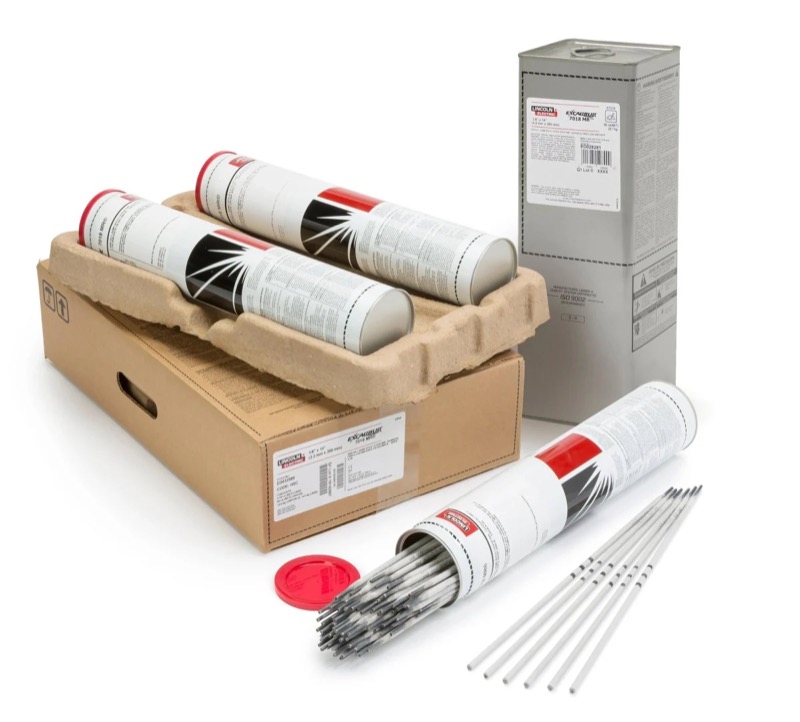
Manual arc welding process using a consumable electrode coated in flux. The flux coating provides shielding gas and slag protection during welding. The most versatile and portable arc welding process, used extensively in construction, pipeline, and maintenance work.
What welding rod should I use?
It depends on the job. For rusty, dirty, or painted steel, use E6010 (DC only) or E6011 (AC or DC). For thin clean sheet metal, use E6013. For structural steel, pressure vessels, or any code work, use E7018. For fast flat fillet welds in production, use E7024. If you only buy one rod for general repairs on an AC welder, make it E6011. On DC, E7018 covers the widest range of serious work.
Stick welding uses a flux-coated consumable electrode that melts into the joint while the flux creates a gas shield and slag layer to protect the weld. It works on DC or AC power, needs no shielding gas bottle, and handles dirty or rusty steel better than any other arc process. The equipment is simple and portable, which is why stick welding remains the dominant process for field work, pipeline construction, and structural steel erection. The trade-off is slower travel speed and the need to chip slag between passes.
Stick Welding Electrodes
E6010
Deep-penetrating pipe welding rod. Burns hot, digs hard, cuts through rust and dirt. DC only.
40-320AE6011
The AC version of 6010. Deep penetration on dirty steel, works on any welder.
40-320AE6012
Gap-bridging rod for poor fit-up joints. Heavy slag, medium penetration. Mostly replaced by E6013.
40-350AE6013
Easy-to-run rod for thin, clean metal. Low penetration, smooth arc, minimal spatter. Great for beginners.
40-300AE7014
Fast-depositing 70 ksi rod for non-critical fillet welds. Like a stronger E6013 with more iron powder.
80-350AE7018
The go-to stick rod for strong, clean welds on structural steel. Runs smooth, low spatter, all positions except vertical-down.
70-400AE7024
High-speed drag rod for flat and horizontal fillet welds only. Maximum deposition, minimal skill required.
100-365AE6020
Heavy-deposition flat and horizontal rod. High iron powder content gives fast fill rates on thick plate.
100-425AE7016
Low-hydrogen rod that runs on AC. The answer when you need E7018-quality welds but only have an AC welder.
55-300AE7018-1
E7018 with mandatory Charpy impact testing at -50F. Required for structural code work and seismic applications.
65-280AAt a Glance
| E6010 | E6011 | E6012 | E6013 | E7014 | E7018 | E7024 | E6020 | E7016 | E7018-1 | |
|---|---|---|---|---|---|---|---|---|---|---|
| Beginner | D | C | B | A | A | B | B | C | B | B |
| Structural | B | B | D | D | C | A | C | D | A | A |
| Pipe | A | B | D | F | F | B | F | F | C | B |
| Repair | B | A | B | B | B | D | D | C | B | D |
| Sheet | D | D | B | A | C | D | D | F | C | D |
| Production | C | C | B | C | B | B | A | A | C | B |
| Fume Level | High | High | Medium | Medium | Medium | Med-Low | Medium | Medium | Med-Low | Med-Low |
| Storage | Standard | Standard | Standard | Standard | Standard | Rod Oven | Standard | Standard | Rod Oven | Rod Oven |
Choosing the Right Stick Welding Consumable
This category covers 10 consumables. Start with the comparison that matches your decision, or use the application guides to find the right rod for a specific job.
Comparisons
E6010 vs E6011
Almost identical rods with one critical difference: E6010 is DC only, E6011 runs on AC too.
E6010 vs E7018
These two rods are partners, not competitors.
E6011 vs E6013
Opposite rods for opposite jobs.
E6013 vs E7018
Two of the most common shop rods, but they exist in different worlds.
E7014 vs E7018
Both are 70 ksi rods.
E7018 vs E7024
E7018 goes anywhere.
E6010 vs E6013
E6010 is a deep-penetrating pipe rod for dirty metal on DC only.
E6012 vs E6013
Both are easy-running 60 ksi rods for general-purpose work, but E6012 has slightly deeper penetration and runs primarily on AC/DCEN, while E6013 runs on all.
Application Guides
Which Welding Rod for Exhaust Pipe Repair
Find the right welding rod for exhaust pipe repair.
Which Welding Rod for Cast Iron Repair
Choose the right welding rod for cast iron repair.
Which Welding Rod for Farm Equipment Repair
The right welding rod for farm equipment repair.
Best All-Around Welding Rod: One Rod to Stock
If you could stock one welding rod for your shop or truck, which should it be? E6011 for versatility, E7018 for strength, E7014 for easy operation.
Best Welding Rod for Beginners to Learn On
Which welding rod should a beginner start with? E6013, E7014, and E6011 compared for ease of learning, forgiveness, and practical results.
Which Welding Rod for Trailer Frame Repair
Choose the right welding rod for trailer frame welding and repair.
Stick Welding Questions
What welding rod should I use?
It depends on the job. For rusty, dirty, or painted steel, use E6010 (DC only) or E6011 (AC or DC). For thin clean sheet metal, use E6013. For structural steel, pressure vessels, or any code work, use E7018. For fast flat fillet welds in production, use E7024. If you only buy one rod for general repairs on an AC welder, make it E6011. On DC, E7018 covers the widest range of serious work. See also: E6010 specifications, E6011 specifications, E6013 specifications, E7018 specifications, E7024 specifications.
What is the best welding rod for a beginner?
Start with E6013. It has the easiest arc start, the most stable arc, and the most forgiving technique of any stick electrode. Once you can run consistent beads in all positions with E6013, move to E7018 to learn low-hydrogen technique for structural work. After that, try E6010 or E6011 to develop the whip-and-pause technique used in pipe welding. Most welding schools follow this progression. See also: E6013 specifications, E7018 specifications, E6010 specifications.
What do the numbers on a welding rod mean?
The AWS classification system packs four things into the number. Take E7018: the E means electrode. The first two digits (70) are the minimum tensile strength in thousands of psi, so 70 means 70,000 psi. The third digit (1) is the welding position, 1 means all positions, 2 means flat and horizontal only. The last digit (8) tells you the coating type and polarity, 8 means low-hydrogen iron powder, AC or DCEP. So E7018 is a 70,000 psi, all-position, low-hydrogen rod.
Related Resources
Weld Defect Troubleshooter
Diagnose defects by electrode type. Select what you see wrong and get rod-specific causes and fixes.
MIG Welding
3 electrodes with amperage charts and specs.
Flux-Core Welding
5 electrodes with amperage charts and specs.
Stainless Stick
5 electrodes with amperage charts and specs.
Stainless MIG/TIG
3 electrodes with amperage charts and specs.
Reference data only. Verify all settings against manufacturer documentation and the applicable welding code before use. Amperage ranges are starting points that vary by position, fit-up, and material. Welding involves serious injury risks including burns, electric shock, fume exposure, and fire. This site does not replace proper training, certification, or employer safety procedures. See full terms of use.