MIG Welding
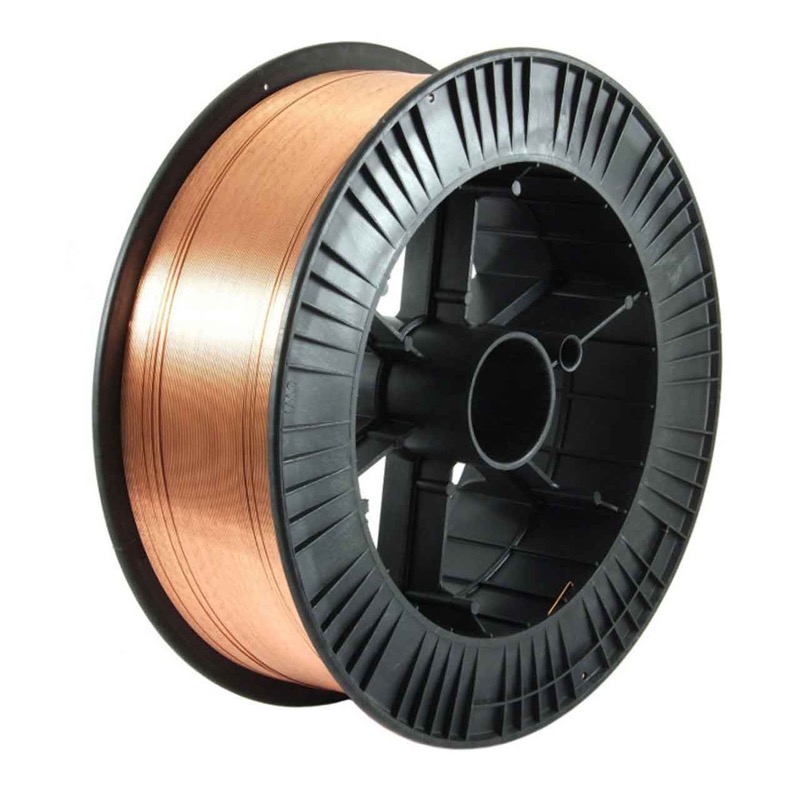
Semi-automatic welding process using a continuously fed solid wire electrode and external shielding gas. Faster than SMAW with less operator skill required. Widely used in manufacturing, fabrication shops, and automotive work.
What MIG wire should I use for mild steel?
ER70S-6 is the default MIG wire for mild steel. It handles light mill scale and produces clean welds with standard 75/25 Ar/CO2 shielding gas. ER70S-3 is a lower-cost alternative for clean material.
MIG welding feeds a solid wire electrode continuously through a gun while shielding gas (typically 75% argon / 25% CO2 for mild steel) protects the weld pool from atmospheric contamination. It is the fastest manual arc welding process for mild steel and produces clean welds with minimal slag. MIG requires a gas bottle and is sensitive to wind, which limits outdoor use. Most production fab shops and auto body facilities default to MIG for its speed, ease of use, and consistent weld quality on clean material.
MIG Welding Electrodes
ER70S-6
The standard MIG wire for mild steel. Works on everything from sheet metal to heavy plate. Handles some rust and oil.
30-350AER70S-3
Cleaner MIG wire for clean steel. Less silicon residue than ER70S-6, but less forgiving on dirty metal.
40-340AER80S-D2
80,000 psi MIG wire with molybdenum for welding high-strength low-alloy (HSLA) steels and 1/2Cr-1/2Mo piping.
50-350AAt a Glance
Choosing the Right MIG Welding Consumable
With 3 options in this category, the choice comes down to the base metal alloy and the service environment. The comparisons below break down the specific differences.
Comparisons
ER70S-3 vs ER70S-6
Same wire, different deoxidizer levels.
E71T-11 vs ER70S-6
Gas or no gas, that is the choice.
ER70S-2 vs ER70S-6
ER70S-2 is primarily a TIG filler rod with superior weld purity.
Solid MIG Wire vs Gas-Shielded Flux-Core for Production Welding
ER70S-6 solid MIG wire vs E71T-1 flux-core for shop fabrication.
High-Strength vs Standard MIG Wire
ER80S-D2 (80 ksi) for HSLA steel vs ER70S-6 (70 ksi) for mild steel.
MIG Wire vs Easy Stick Rod for Beginners
ER70S-6 solid MIG wire vs E6013 easy-run stick rod.
Structural Stick Rod vs MIG Wire for Mild Steel
E7018 low-hydrogen stick vs ER70S-6 MIG wire.
Application Guides
Which Welding Rod for Exhaust Pipe Repair
Find the right welding rod for exhaust pipe repair.
Which Welding Rod for Trailer Frame Repair
Choose the right welding rod for trailer frame welding and repair.
Which Welding Rod for Thin Sheet Metal
Choose the right welding rod for thin sheet metal.
Best Flux-Core Wire for Beginners
Which flux-core wire should a beginner buy? E71T-GS vs E71T-11 compared for small MIG welders, hobby projects, and learning to weld without gas.
Which Welding Rod for Galvanized Steel
How to weld galvanized steel safely.
Which Welding Rod for Structural Steel
Choose the correct welding rod for structural steel.
MIG Wire Questions
What MIG wire should I use for mild steel?
ER70S-6 is the default MIG wire for mild steel. It handles light mill scale and produces clean welds with standard 75/25 Ar/CO2 shielding gas. ER70S-3 is a lower-cost alternative for clean material.
What size MIG wire should I use?
0.030 inch wire for thin material (up to 3/16 inch). 0.035 inch for general-purpose work on 3/16 to 3/8 inch material. 0.045 inch for thicker material in production settings.
What shielding gas for MIG welding steel?
75% argon / 25% CO2 is the standard mix for mild steel MIG welding. 100% CO2 gives deeper penetration but more spatter. For stainless, use tri-mix or 98/2 Ar/CO2.
Related Resources
Weld Defect Troubleshooter
Diagnose defects by electrode type. Select what you see wrong and get rod-specific causes and fixes.
Stick Welding
10 electrodes with amperage charts and specs.
Flux-Core Welding
5 electrodes with amperage charts and specs.
Stainless Stick
5 electrodes with amperage charts and specs.
Stainless MIG/TIG
3 electrodes with amperage charts and specs.
Reference data only. Verify all settings against manufacturer documentation and the applicable welding code before use. Amperage ranges are starting points that vary by position, fit-up, and material. Welding involves serious injury risks including burns, electric shock, fume exposure, and fire. This site does not replace proper training, certification, or employer safety procedures. See full terms of use.