ORFS Fitting Thread Sizes: O-Ring Face Seal SAE J1453 Data
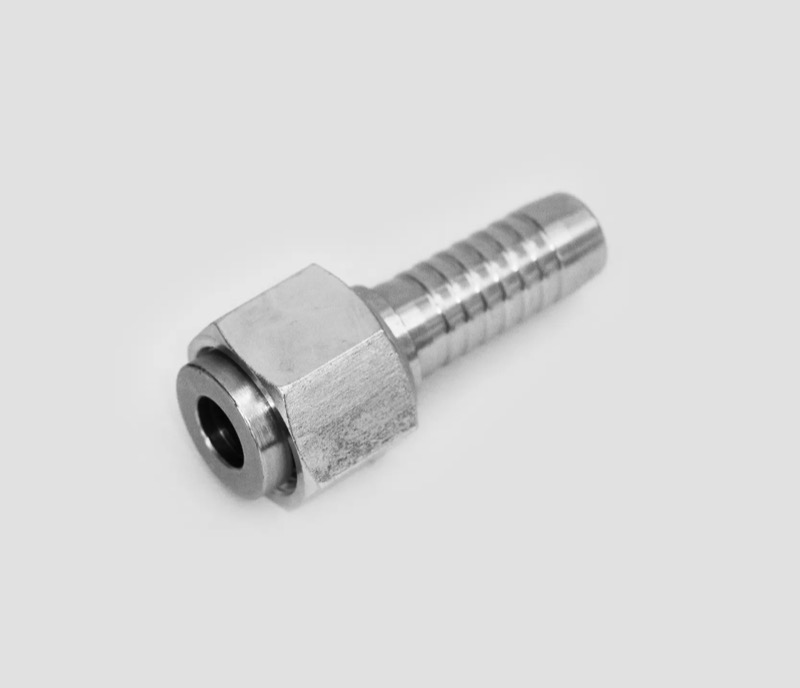
ORFS (SAE J1453) uses Straight threads with a o-ring face seal per SAE J1453. Thread dimension table and identification tips below.
Thread Sizes
| Dash Size | Tube OD | Thread |
|---|---|---|
| -4 | 1/4" | 9/16-18 UNF |
| -6 | 3/8" | 11/16-16 UN |
| -8 | 1/2" | 13/16-16 UN |
| -10 | 5/8" | 1-14 UNS |
| -12 | 3/4" | 1-3/16-12 UN |
| -16 | 1" | 1-7/16-12 UN |
| -20 | 1-1/4" | 1-11/16-12 UN |
| -24 | 1-1/2" | 2-12 UN |
ORFS is the leak-proof fitting. An O-ring sits in a groove on the flat face of the fitting and seals against a flat machined surface. No thread sealant, no flare quality to worry about. When you need zero leaks in a high-pressure, high-vibration environment, ORFS is the answer. The downside is cost and you cannot field-fabricate the tube end without proper tooling.
When to Use ORFS
High-vibration mobile equipment, factory automation, and any application where zero leaks are required.
ORFS is the upgrade from JIC when vibration causes JIC flares to loosen over time.
Many OEMs are switching to ORFS for new machine designs.
Where ORFS Falls Short
More expensive than JIC. Requires proper O-ring replacement if the seal is damaged.
Cannot field-fabricate tube ends without an ORFS flaring tool.
The O-ring is an additional failure point compared to metal-to-metal JIC.
How to Identify ORFS Fittings
Flat face with a visible O-ring groove. Straight threads (not tapered). The nut has a smooth bore for the tube to pass through.
Measurement Tips
ORFS fittings use a captive O-ring that sits in a groove on the flat face of the male fitting. When you tighten the nut, the O-ring compresses against the flat face of the female port. This creates a positive seal that does not rely on thread deformation or metal-to-metal contact. The O-ring does all the sealing work, which is why ORFS can be assembled and disassembled repeatedly without degrading the seal.
What ORFS Gets Confused With
ORFS and face seal O-ring boss (ORB / SAE J1926) are different standards. ORB uses an O-ring boss on a port with straight threads, while ORFS uses an O-ring on the face of the fitting itself. The O-ring location and the sealing mechanism are different. ORFS is a tube fitting standard. ORB is a port standard. They solve different connection problems.
ORFS (SAE J1453): Common Questions
What does ORFS stand for?
O-Ring Face Seal, defined by SAE J1453. The fitting has a captive O-ring that sits in a groove on a flat face. When tightened, the O-ring compresses against the mating flat surface, creating a positive seal that is virtually leak-free even under vibration and pressure cycling.
Is ORFS better than JIC?
For vibration resistance and leak prevention, yes. ORFS has a captive O-ring seal that absorbs movement, while JIC relies on metal-to-metal contact at a 37-degree flare that can loosen under vibration. ORFS costs more and is less commonly stocked at local suppliers. For standard mobile hydraulics without severe vibration, JIC is sufficient and more economical. The full ORFS vs JIC comparison covers pressure ratings, cost, and when to upgrade.
Do ORFS fittings need Teflon tape?
No. The O-ring provides the seal. Do not apply Teflon tape, pipe compound, or any sealant to ORFS fittings. Sealant can contaminate the hydraulic system and prevent the O-ring from seating properly. Tighten to the manufacturer's torque specification and the O-ring does the rest. For assembly torque values by size, see the hydraulic fitting torque specs.
Reference data only. Verify thread dimensions with a thread identification gauge before making connections. Working with pressurized hydraulic systems involves serious injury risks including high-pressure injection, burns, and crushing hazards. This site does not replace manufacturer specifications, proper training, or employer safety procedures. See full terms of use.
Data sourced from SAE J1453. Thread dimensions are nominal values. Always verify with a thread identification gauge before making connections.