E6013 Welding Rod: Amperage Chart, Settings & Beginner Guide
Easy-to-run rod for thin, clean metal. Runs 40 to 300 amps on AC or DCEP or DCEN, rated for flat, horizontal, vertical up, overhead. Amperage chart by diameter below.
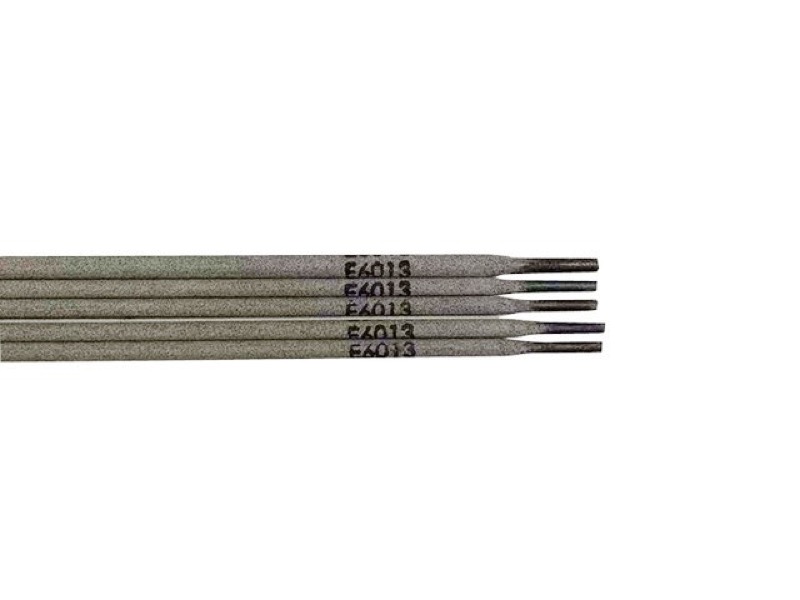
E6013 is the easiest stick rod to run. It strikes easily, holds a stable arc, and produces a clean bead with very little spatter. The trade-off is low penetration, it sits on top of the metal more than it digs in. That makes it ideal for sheet metal and thin material where you do not want to burn through, but a poor choice for anything structural. If you are learning to weld, this is a good rod to start with.
What This Means in Practice
E6013 is the rod most welding instructors hand to a student on day one. The arc is gentle, the slag peels easily, and the bead looks good even when your technique is rough. It is also the default choice for thin gauge sheet metal work, auto body fabrication, and any joint where the steel is clean and penetration requirements are low.
What Amps for E6013?
| Diameter | Amperage Range |
|---|---|
| 3/32" (2.4 mm) | 40 - 90A |
| 1/8" (3.2 mm) | 70 - 120A |
| 5/32" (4 mm) | 105 - 180A |
| 3/16" (4.8 mm) | 150 - 230A |
| 1/4" (6.4 mm) | 200 - 300A |
Amperage by Individual Diameter
3/32 E6013 Amperage
Set 3/32 E6013 to 40 - 90 amps. Run AC or DCEP or DCEN. This is the smallest available size. Best for vertical-up and overhead where you need a small, controllable puddle. Start around 65A.
1/8 E6013 Amperage
Set 1/8 E6013 to 70 - 120 amps. Run AC or DCEP or DCEN. This is the most commonly used E6013 size. Start at 95A for flat work, drop to 70-86A for vertical-up.
5/32 E6013 Amperage
Set 5/32 E6013 to 105 - 180 amps. Run AC or DCEP or DCEN. Sized for vertical and overhead joints. Stay in the 105-143A range and keep the puddle small.
3/16 E6013 Amperage
Set 3/16 E6013 to 150 - 230 amps. Run AC or DCEP or DCEN. Built for flat and horizontal production. Back off 10-15A from 230 if the bead crowns.
1/4 E6013 Amperage
Set 1/4 E6013 to 200 - 300 amps. Run AC or DCEP or DCEN. Largest available diameter. High deposition for flat and horizontal fillet welds on thick plate. Requires 200A minimum to run properly.
E6013 Suitability Scores
How well this electrode matches common applications. Not a quality rating. all AWS-certified electrodes meet their specification.
What Is E6013 Good For?
Sheet metal and thin material (20 gauge to 3/16 inch).
Clean, new mild steel in a shop.
Learning to weld and practicing basic technique.
Light fabrication, non-structural brackets, and cosmetic welds.
Any application where appearance matters more than strength.
Where E6013 Falls Short
Low penetration means poor fusion on thick material.
Not for structural, code, or load-bearing work.
Needs clean base metal to work properly, struggles with rust and mill scale.
Welds are weaker than E7018 (60 ksi vs 70 ksi tensile).
E6013 Under the Hood
Arc Behavior
Quiet, smooth arc with a soft hiss. No snapping, no digging. The arc sits on top of the base metal instead of boring into it. Beginners find this rod forgiving because it does not punish bad arc length.
How to Move
Drag the rod at a 10-15 degree angle. No whipping needed. Keep a steady pace and let the puddle flow. The rod practically runs itself on flat joints. For vertical-up, use a slight weave to build the shelf.
What the Puddle Does
Wide, fluid puddle that spreads easily and wets out to the toes. Heavy slag forms a complete blanket over the weld. The slag peels off in long ribbons when it cools. The finished bead is smooth with fine, even ripples.
Troubleshooting
If the bead is tall and narrow, slow down and let the puddle spread. If you are burning through on thin metal, drop your amps 10A at a time until the puddle holds. This rod forgives hesitation, so do not rush.
Which Size E6013 to Use
| Rod Diameter | Material Thickness | Application |
|---|---|---|
| 3/32" | 1/16" to 3/32" | Sheet metal and auto body panels |
| 1/8" | 3/32" to 3/16" | Light structural and general fabrication |
| 5/32" | 3/16" to 1/4" | Maximum practical thickness for E6013 |
From the Field
E6013 is the rod that teaches beginners to weld without destroying their confidence. The beads look good on day one. The danger is staying on E6013 too long. It flatters your technique by hiding bad habits. You can run beautiful beads with E6013 that have zero penetration into the base metal. If you peel the weld off with a hammer, you stayed too cold or traveled too fast. Use E6013 to learn hand control, then move to E7018 for real structural work.
Bottom Line
Beginner work is where E6013 belongs. Pipe is not its job. When E6013 is wrong for the job, reach for E6011.
Setup & Safety Reference
How to Store E6013
Standard dry storage at room temperature.
Preheat & Interpass Temperature for E6013
Preheat varies by base metal thickness. Non-low-hydrogen electrodes require higher preheat on thick material.
| Base Metal Thickness | Minimum Preheat (°F) |
|---|---|
| up to 3/4" | Not required |
| 3/4" to 1-1/2" | 150°F |
| 1-1/2" to 2-1/2" | 225°F |
| over 2-1/2" | 300°F |
Maximum interpass temperature: 600°F
Source: AWS D1.1 Table 3.2, Category A (non-low-hydrogen)
Fume Generation
Rating: Medium
Typical fume rate: 0.4-0.7 g/min
Moderate fume. Lower than cellulose electrodes.
Common Brand Names for E6013
4 manufacturers sell an E6013 product. Lincoln Electric Fleetweld 37 is the one most shops stock.
| Manufacturer | Product Name | Notes |
|---|---|---|
| Lincoln Electric | Fleetweld 37 | |
| Hobart | Hobart 413 | |
| ESAB | Sureweld 6013 | |
| Forney | E6013 |
Full Specs
| Property | Value |
|---|---|
| AWS Classification | E6013 |
| Process | Stick Welding (SMAW) |
| Polarity | AC, DCEP, DCEN |
| Positions | flat, horizontal, vertical up, overhead |
| Penetration | light |
| Coating Type | high titania potassium |
| Tensile Strength | 60,000 psi |
| Yield Strength | 48,000 psi |
| Elongation | 17% |
| Base Metals | carbon steel, low-carbon steel |
| Shielding Gas | Flux-shielded (no external gas) |
| Max Interpass Temp | 600°F |
| AWS Specification | AWS A5.1/A5.1M:2012 |
E6013 FAQ
What welding rod for thin sheet metal?
E6013 in 3/32 inch diameter at low amperage (40-80A). E6013 has the lowest penetration of any common stick rod, which means it sits on top of the metal rather than burning through. That makes it ideal for sheet metal, auto body panels, and thin-wall tubing. Use DCEN (straight polarity) for even less penetration on very thin stock. If you are still burning through, switch to a MIG process with ER70S-6 wire, which gives better heat control on thin material. For very thin material, MIG with ER70S-6 specifications gives finer heat control than stick.
Is E6013 good for beginners?
E6013 is the easiest stick rod to run. It strikes with a light scratch, holds a stable arc even at low amperage, and produces clean beads with very little spatter. The slag practically falls off. Most welding instructors start students on E6013 to develop arc control and bead technique before moving to more demanding rods like E6010 or E7018. The downside is E6013 has low penetration and is only 60,000 psi, so it is not suitable for structural work. Once comfortable with E6013, most students progress to E7018 specifications for structural practice. See also: E6013 vs E7018 comparison.
Can E6013 weld structural steel?
No. E6013 should not be used for structural, load-bearing, or code-governed joints. It has low penetration, which increases the risk of lack-of-fusion defects, and its 60,000 psi tensile strength is below the 70,000 psi typically required for structural welding per AWS D1.1. Use E7018 for structural work. See also: E7018 specifications, E6013 vs E7018 comparison.
Where to Buy E6013
As an Amazon Associate, GageRef earns from qualifying purchases. These are affiliate links.
Manufacturer Data Sheets
External links to standards bodies and manufacturers. These leave GageRef.
Reference data only. Verify all settings against manufacturer documentation and the applicable welding code before use. Amperage ranges are starting points that vary by position, fit-up, and material. Welding involves serious injury risks including burns, electric shock, fume exposure, and fire. This site does not replace proper training, certification, or employer safety procedures. See full terms of use.
Data sourced from AWS A5.1/A5.1M. Amperage ranges are approximate starting points. adjust based on position, fit-up, and material thickness. Always follow manufacturer recommendations and applicable codes.