E7018-1 Impact-Tested Structural Low-Hydrogen Rod
E7018 with mandatory Charpy impact testing at -50F. Runs 65 to 280 amps on AC or DCEP, rated for flat, horizontal, vertical up, overhead. Amperage chart by diameter below.
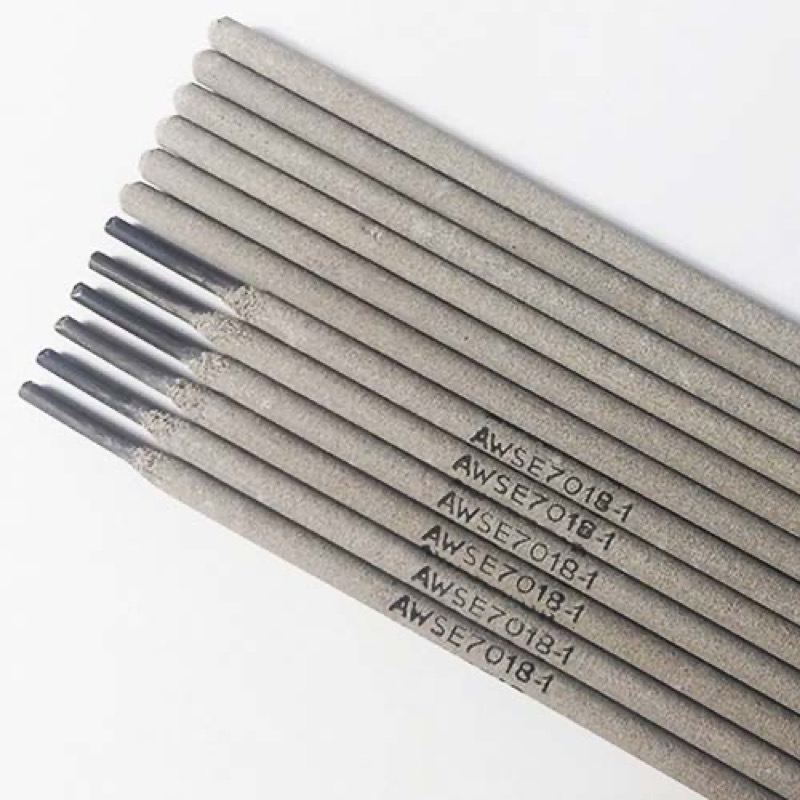
E7018-1 is a low-hydrogen iron powder electrode classified under AWS A5.1. It is mechanically identical to E7018 but with a mandatory additional requirement: Charpy V-notch impact testing at -50F (-46C) with a minimum of 20 ft-lbs average. Standard E7018 requires impact testing at -20F (-29C). This additional toughness requirement makes E7018-1 the specified electrode for structural steel welding in cold climates, seismic applications (AWS D1.8), and critical structures where the Welding Procedure Specification (WPS) calls out -1 grade material. E7018-1 runs identically to E7018 on DCEP or AC, with the same smooth arc, low spatter, and heavy slag coverage. Storage and baking requirements are the same as standard E7018.
What This Means in Practice
E7018-1 is identical to E7018 in chemistry and operation, but the -1 suffix means it must pass Charpy V-notch impact testing at -50F (-46C). Standard E7018 requires impact testing at -20F (-29C). This matters for structural steel in cold climates, seismic zones, and any code work where the engineer specifies E7018-1 on the WPS.
What Amps for E7018-1?
| Diameter | Amperage Range |
|---|---|
| 3/32" (2.4 mm) | 65 - 110A |
| 1/8" (3.2 mm) | 100 - 160A |
| 5/32" (4 mm) | 140 - 220A |
| 3/16" (4.8 mm) | 170 - 280A |
Amperage by Individual Diameter
3/32 E7018-1 Amperage
Set 3/32 E7018-1 to 65 - 110 amps. Run AC or DCEP. This is the smallest available size. Best for vertical-up and overhead where you need a small, controllable puddle. Start around 88A.
1/8 E7018-1 Amperage
Set 1/8 E7018-1 to 100 - 160 amps. Run AC or DCEP. This is the most commonly used E7018-1 size. Start at 130A for flat work, drop to 100-117A for vertical-up.
5/32 E7018-1 Amperage
Set 5/32 E7018-1 to 140 - 220 amps. Run AC or DCEP. Built for flat and horizontal production. Back off 10-15A from 220 if the bead crowns.
3/16 E7018-1 Amperage
Set 3/16 E7018-1 to 170 - 280 amps. Run AC or DCEP. Largest available diameter. High deposition for flat and horizontal fillet welds on thick plate. Requires 170A minimum to run properly.
E7018-1 Suitability Scores
How well this electrode matches common applications. Not a quality rating. all AWS-certified electrodes meet their specification.
What Is E7018-1 Good For?
Use E7018-1 when the WPS or engineering specification requires impact testing at -50F.
Required for AWS D1.1 structural steel in seismic zones, bridge construction in cold climates, and any application where sub-zero toughness is specified.
Also use when you want the assurance of impact-tested weld metal even if the code does not strictly require it.
Where E7018-1 Falls Short
Same limitations as E7018: requires dry storage or rod oven, moisture sensitive, cannot weld on rusty or dirty metal.
Slightly more expensive than standard E7018 due to the additional testing requirements.
Not necessary for non-code shop work where impact toughness at -50F is irrelevant.
How E7018-1 Handles
What You Hear and See
Identical to E7018. Smooth, quiet arc with a steady hum. The added toughness specification (-1 suffix) does not change how the rod runs. You cannot feel the difference.
Running It
Same drag technique as E7018. Tight arc, 5-15 degrees from vertical, consistent travel speed. Everything about running E7018-1 is the same as E7018.
Puddle and Slag
Same as E7018. Large, slow puddle with heavy, self-peeling slag. The bead profile is flat to slightly convex with fine ripples. The mechanical difference is only visible on a Charpy impact test at -50F.
If You Are Struggling
If you can run E7018, you can run E7018-1. There is no technique difference. The only reason to choose E7018-1 over E7018 is when the WPS or code specifies impact testing at -50F.
Matching E7018-1 Diameter to Your Steel
| Rod Diameter | Material Thickness | Application |
|---|---|---|
| 3/32" | 1/8" to 3/16" | Thin plate, cold-climate structural |
| 1/8" | 3/16" to 3/8" | Standard seismic and cold-climate work |
| 5/32" | 3/8" to 3/4" | Heavy structural, seismic connections |
From the Field
E7018-1 is E7018 with a -50F Charpy impact guarantee. The toughness at low temperature is what separates it. AWS D1.8 (Seismic Supplement to Structural Welding Code) requires E7018-1 for demand-critical connections in high seismic zones. Cold-climate structural work in Alaska, Canada, and northern states also calls for E7018-1 to prevent brittle fracture at low service temperatures. Same rod, same technique, tighter quality control.
Bottom Line
E7018-1 earns its keep on structural jobs. It has no business on repair applications. The closest alternative is E7018.
Setup & Safety Reference
How to Store E7018-1
Low-hydrogen electrode. Moisture control is critical.
Oven Holding Temperature: 250-300°F
Max Atmosphere Exposure: 4 hours before rebaking required
Rebake Temperature: 500-800°F for 1-2 hours
Low-hydrogen electrode with improved toughness. Same strict storage as E7018. Critical for low-temperature service.
Preheat & Interpass Temperature for E7018-1
Preheat varies by base metal thickness. Low-hydrogen processes require less preheat than non-low-hydrogen.
| Base Metal Thickness | Minimum Preheat (°F) |
|---|---|
| up to 3/4" | Not required |
| 3/4" to 1-1/2" | 50°F |
| 1-1/2" to 2-1/2" | 150°F |
| over 2-1/2" | 225°F |
Maximum interpass temperature: 600°F
Source: AWS D1.1 Table 3.2, Category B (low-hydrogen)
Fume Generation
Rating: Medium-Low
Typical fume rate: 0.3-0.6 g/min
Same low fume profile as E7018.
Common Brand Names for E7018-1
3 manufacturers sell an E7018-1 product. Lincoln Electric Excalibur 7018-1 MR is the one most shops stock.
| Manufacturer | Product Name | Notes |
|---|---|---|
| Lincoln Electric | Excalibur 7018-1 MR | Improved toughness to -50F |
| ESAB | Atom Arc 7018-1 | |
| Hobart | Hobart 718MC (select) |
Full Specs
| Property | Value |
|---|---|
| AWS Classification | E7018-1 |
| Process | Stick Welding (SMAW) |
| Polarity | AC, DCEP |
| Positions | flat, horizontal, vertical up, overhead |
| Penetration | medium |
| Coating Type | low-hydrogen iron powder |
| Tensile Strength | 70,000 psi |
| Yield Strength | 58,000 psi |
| Elongation | 22% |
| Impact Toughness | 20 ft-lbs at -50°F |
| Base Metals | Carbon steel, Low-alloy steel, Structural steel (A36, A572, A992) |
| Shielding Gas | Flux-shielded (no external gas) |
| Max Interpass Temp | 600°F |
| AWS Specification | AWS A5.1/A5.1M:2012 |
Frequently Asked Questions
What is the difference between E7018 and E7018-1?
The only difference is impact testing temperature. Standard E7018 must pass Charpy impact testing at -20F (-29C). E7018-1 must pass at -50F (-46C). The chemistry, operating characteristics, storage requirements, and amperage settings are identical. Use E7018-1 when the WPS or engineering specification requires impact testing at -50F, such as for structural work in seismic zones or cold climates.
Can I use E7018-1 as a regular E7018?
Yes. E7018-1 exceeds all requirements for standard E7018. It runs the same, stores the same, and welds the same. The -1 grade simply guarantees additional low-temperature toughness. There is no downside to using E7018-1 where E7018 is specified, other than slightly higher cost.
Does E7018-1 need a rod oven?
Yes. E7018-1 has the same low-hydrogen storage requirements as standard E7018. Store at 250-300F in a rod oven after opening. Maximum atmospheric exposure is 4 hours for H4R grades. Rods exposed to moisture must be reconditioned at 700F for 1 hour. Moisture contamination causes porosity and hydrogen cracking, especially on thick structural steel.
Where to Buy E7018-1
As an Amazon Associate, GageRef earns from qualifying purchases. These are affiliate links.
Manufacturer Data Sheets
External links to standards bodies and manufacturers. These leave GageRef.
Reference data only. Verify all settings against manufacturer documentation and the applicable welding code before use. Amperage ranges are starting points that vary by position, fit-up, and material. Welding involves serious injury risks including burns, electric shock, fume exposure, and fire. This site does not replace proper training, certification, or employer safety procedures. See full terms of use.
Data sourced from AWS A5.1/A5.1M. Amperage ranges are approximate starting points. adjust based on position, fit-up, and material thickness. Always follow manufacturer recommendations and applicable codes.