Flux-Core Welding
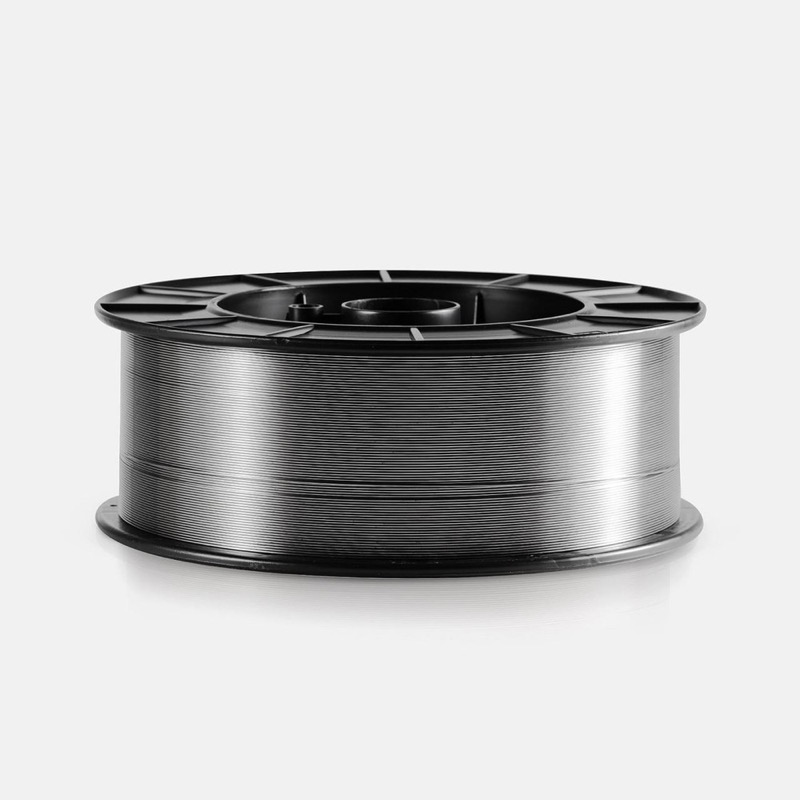
Semi-automatic welding process using a tubular wire filled with flux. Available in self-shielded (no gas required) and gas-shielded variants. Combines the portability of SMAW with the speed of GMAW. Commonly used in structural steel, shipbuilding, and outdoor fabrication.
Flux-core welding feeds a tubular wire filled with flux compounds. Self-shielded varieties (like E71T-11) need no gas bottle, which makes them practical for outdoor and field work. Gas-shielded varieties (like E71T-1) use CO2 or mixed gas and produce higher-quality welds at faster speeds than solid MIG wire. Flux-core is the go-to process when you need MIG-like productivity but cannot control the environment. The trade-off is more spatter and a slag layer that needs removal.
Flux-Core Welding Electrodes
Self-Shielded (No Gas Required)
These wires use flux in the core to shield the weld. No gas bottle, regulator, or hose needed. Best for outdoor work, field repairs, and portability.
E71T-11
Flux-core wire that needs no gas. Best for outdoor welding, farm repairs, and field work.
30-225AE71T-GS
Single-pass flux-core wire for thin steel and home projects. The small spool you find at hardware stores.
25-150AE71T-8
Self-shielded flux-core wire with seismic demand classification. Approved for AWS D1.8 welding in seismic zones.
130-350AGas-Shielded
These wires require external shielding gas (typically 75/25 argon/CO2 or 100% CO2). Higher deposition rates and better mechanical properties than self-shielded, but limited to indoor or sheltered work.
E71T-1
Gas-shielded flux-core for production welding. Higher deposition than solid MIG wire with better out-of-position performance.
150-500AE81T1-Ni1
Gas-shielded nickel flux-core wire rated for -40F impact toughness. For low-temperature structural and pressure vessel work.
130-380AAt a Glance
| E71T-11 | E71T-GS | E71T-1 | E71T-8 | E81T1-Ni1 | |
|---|---|---|---|---|---|
| Beginner | C | B | D | D | D |
| Structural | C | D | A | A | B |
| Pipe | D | F | C | D | C |
| Repair | A | B | D | C | D |
| Sheet | D | C | D | D | D |
| Production | B | C | A | A | A |
| Fume Level | High | High | Medium | High | Medium |
Choosing the Right Flux-Core Welding Consumable
This category covers 5 consumables. Start with the comparison that matches your decision, or use the application guides to find the right rod for a specific job.
Comparisons
E71T-11 vs ER70S-6
Gas or no gas, that is the choice.
E71T-11 vs E71T-GS
Both are self-shielded flux-core wires that work without gas.
E71T-1 vs E71T-11
E71T-1 is gas-shielded flux-core for production shops.
E7018 vs E71T-11
E7018 is the standard code-quality stick rod.
Stick vs Gas-Shielded Flux-Core for Structural Steel
E7018 stick vs E71T-1 gas-shielded flux-core for structural welding.
Solid MIG Wire vs Gas-Shielded Flux-Core for Production Welding
ER70S-6 solid MIG wire vs E71T-1 flux-core for shop fabrication.
Cellulose Stick vs Self-Shielded Flux-Core for Field Welding
E6010 stick vs E71T-11 self-shielded flux-core for outdoor and field repair.
Seismic-Rated vs General-Purpose Self-Shielded Flux-Core
E71T-8 seismic-rated structural wire vs E71T-11 general-purpose self-shielded.
Application Guides
Which Welding Rod for Farm Equipment Repair
The right welding rod for farm equipment repair.
Which Welding Rod for Trailer Frame Repair
Choose the right welding rod for trailer frame welding and repair.
Which Welding Rod for Rusty or Dirty Metal
Which welding rod handles rust, paint, and dirty surfaces best? E6010 and E6011 compared for welding on contaminated metal without full prep.
Best Flux-Core Wire for Beginners
Which flux-core wire should a beginner buy? E71T-GS vs E71T-11 compared for small MIG welders, hobby projects, and learning to weld without gas.
Which Welding Rod for Structural Steel
Choose the correct welding rod for structural steel.
Which Welding Rod for Pipe: Root, Fill & Cap
Which welding rod for pipe? E6010 for root passes, E7018 for fill and cap.
Flux-Core Wire Questions
What is the difference between gas-shielded and self-shielded flux-core?
Gas-shielded flux-core (E71T-1) requires external shielding gas and gives higher deposition rates and better mechanical properties. Self-shielded flux-core (E71T-11, E71T-GS) needs no gas, making it practical for outdoor and field welding.
Can you use flux-core wire without gas?
Only self-shielded types like E71T-11 and E71T-GS. Gas-shielded types like E71T-1 require shielding gas. Check the wire classification before welding without gas.
Related Resources
Weld Defect Troubleshooter
Diagnose defects by electrode type. Select what you see wrong and get rod-specific causes and fixes.
Stick Welding
10 electrodes with amperage charts and specs.
MIG Welding
3 electrodes with amperage charts and specs.
Stainless Stick
5 electrodes with amperage charts and specs.
Stainless MIG/TIG
3 electrodes with amperage charts and specs.
Reference data only. Verify all settings against manufacturer documentation and the applicable welding code before use. Amperage ranges are starting points that vary by position, fit-up, and material. Welding involves serious injury risks including burns, electric shock, fume exposure, and fire. This site does not replace proper training, certification, or employer safety procedures. See full terms of use.