E6012 vs E6013: Which General-Purpose Stick Rod to Use
Both are easy-running 60 ksi rods for general-purpose work, but E6012 has slightly deeper penetration and runs primarily on AC/DCEN, while E6013 runs on all...
E6012: When you need slightly more penetration than E6013 provides. E6013: General-purpose fabrication.
Which One Should You Use?
Pick E6012 if:
When you need slightly more penetration than E6013 provides. Bridging poor fit-up or gaps. You are running AC or DCEN and want more dig than E6013.
Runs on AC, DCEN, 40-350A range. E6012 full amperage chart
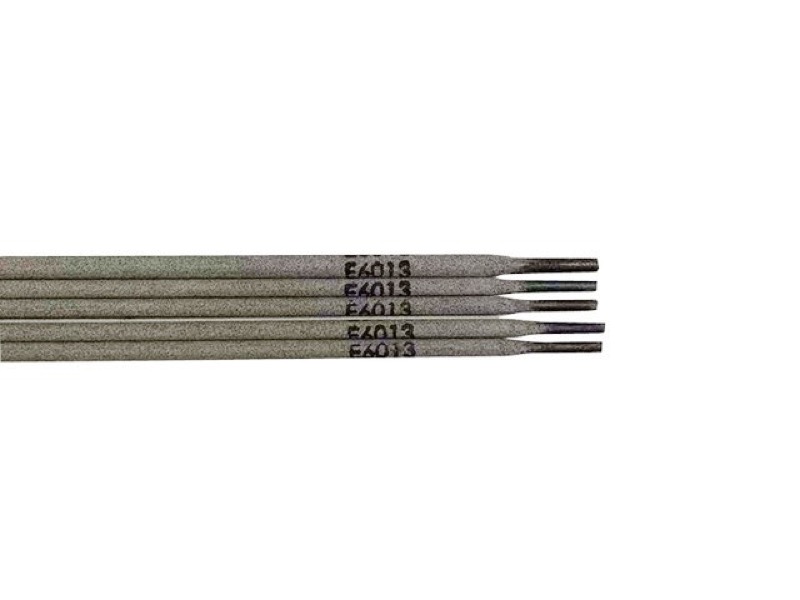
Pick E6013 if:
General-purpose fabrication. Thin material. You want the smoothest possible arc. Beginners learning to weld. Any polarity machine.
Runs on AC, DCEP, DCEN, 40-300A range. E6013 full amperage chart
Key Differences
| Attribute | E6012 | E6013 |
|---|---|---|
| Flux Type | Sodium-based rutile flux | Potassium-based rutile flux for a smoother, softer arc |
| Penetration | Medium penetration; better for bridging gaps and poor fit-up | Lighter penetration; better for thin material where burn-through is a concern |
| Polarity | AC or DCEN | AC, DCEP, or DCEN; runs well on any polarity |
| Bead Profile | Slightly convex bead with moderate slag coverage | Flatter, smoother bead profile with easy slag removal |
Settings at a Glance
Machine settings and operating characteristics side by side. For full amperage charts, see the individual electrode pages.
| Setting | E6012 | E6013 |
|---|---|---|
| Polarity | AC, DCEN | AC, DCEP, DCEN |
| Positions | flat, horizontal, vertical-up, overhead | flat, horizontal, vertical-up, overhead |
| Penetration | medium | light |
| Coating | high titania sodium | high titania potassium |
| Amps at 3/32" | 40-90A | 40-90A |
| Amps at 1/8" | 80-140A | 70-120A |
| Amps at 5/32" | 110-190A | 105-180A |
How E6012 and E6013 Work Together
In practice, E6013 has largely replaced E6012 in most shops. E6013 is more versatile on different polarities and produces a nicer bead. E6012 holds a niche for gap bridging and slightly heavier work.
Common Mistake With E6012
Expecting a significant performance difference. These are very similar rods. The choice usually comes down to what your local supplier stocks.
Practical Differences
| Factor | E6012 | E6013 |
|---|---|---|
| Common Brands | Fleetweld 7, Hobart 12A | Fleetweld 37, Hobart 413 |
Where to Buy
As an Amazon Associate, GageRef earns from qualifying purchases. These are affiliate links.
E6012 vs E6013: Common Questions
Which is better, E6012 or E6013?
Wrong question. They solve different problems. Key differences: Flux Type: E6012 has sodium-based rutile flux, while E6013 has potassium-based rutile flux for a smoother, softer arc. Penetration: E6012 has medium penetration; better for bridging gaps and poor fit-up, while E6013 has lighter penetration; better for thin material where burn-through is a concern. Polarity: E6012 has ac or dcen, while E6013 has ac, dcep, or dcen; runs well on any polarity. The comparison table on this page breaks down each trade-off.
Can I substitute E6012 for E6013?
Only if the specs allow it. E6012 runs on AC/DCEN, E6013 on AC/DCEP/DCEN. Your machine decides. Penetration differs: E6012 is medium, E6013 is light. Coating chemistry is different (high titania sodium vs high titania potassium), so the arc and slag behave differently.
Can I use both E6012 and E6013 on the same joint?
In practice, E6013 has largely replaced E6012 in most shops. E6013 is more versatile on different polarities and produces a nicer bead. E6012 holds a niche for gap bridging and slightly heavier work.
Reference data only. Verify all settings against manufacturer documentation and the applicable welding code before use. Amperage ranges are starting points that vary by position, fit-up, and material. Welding involves serious injury risks including burns, electric shock, fume exposure, and fire. This site does not replace proper training, certification, or employer safety procedures. See full terms of use.
Data sourced from AWS A5.1.