ER70S-6 MIG Wire: Settings, Gas & Amperage Chart
The standard MIG wire for mild steel. Runs 30 to 350 amps on DCEP, rated for flat, horizontal, vertical up, overhead. Amperage chart by diameter below.
ER70S-6 is the default MIG wire. If you buy a spool of MIG wire at any welding supply store without specifying a type, this is what you get. The high silicon and manganese content lets it handle lightly rusted or oily steel better than other MIG wires, and it produces smooth beads with good wetting. It runs on DCEP with 75/25 argon/CO2 or 100% CO2 shielding gas.
What This Means in Practice
ER70S-6 is the wire you are already using if you own a MIG welder. It is the default spool shipped with most machines and the wire most shops stock. The higher silicon content (0.80-1.15%) gives it better wetting action and forgiveness on lightly contaminated steel compared to ER70S-3. The downside is a glassy silicon residue on multi-pass welds that can trap contaminants if not cleaned between passes.
What Amps for ER70S-6?
| Diameter | Amperage Range |
|---|---|
| 0.023" (0.6 mm) | 30 - 90A |
| 0.030" (0.8 mm) | 40 - 145A |
| 0.035" (0.9 mm) | 50 - 220A |
| 0.045" (1.2 mm) | 75 - 350A |
Amperage by Individual Diameter
0.023 ER70S-6 Amperage
Set 0.023 ER70S-6 to 30 - 90 amps. Run DCEP. This is the smallest available size. Best for vertical-up and overhead where you need a small, controllable puddle. Start around 60A.
0.030 ER70S-6 Amperage
Set 0.030 ER70S-6 to 40 - 145 amps. Run DCEP. A versatile mid-range size. Start at 93A and adjust: lower for thin material and out-of-position work, higher for flat fillets on thicker stock.
0.035 ER70S-6 Amperage
Set 0.035 ER70S-6 to 50 - 220 amps. Run DCEP. Built for flat and horizontal production. Back off 10-15A from 220 if the bead crowns.
0.045 ER70S-6 Amperage
Set 0.045 ER70S-6 to 75 - 350 amps. Run DCEP. Largest available diameter. High deposition for flat and horizontal fillet welds on thick plate. Requires 75A minimum to run properly.
ER70S-6 Suitability Scores
How well this electrode matches common applications. Not a quality rating. all AWS-certified electrodes meet their specification.
What Is ER70S-6 Good For?
General shop welding on mild steel.
Auto body and frame repair.
Anything from sheet metal to heavy plate.
Production and robotic welding.
The default MIG wire for most mild steel applications.
Where ER70S-6 Falls Short
Needs shielding gas at all times.
Wind blows the gas away, so it is not great outdoors without wind screens.
Can leave silicon islands on the surface that need to be cleaned before painting.
Higher deoxidizer content than ER70S-3.
How ER70S-6 Feeds
Arc Behavior
Smooth, quiet hiss with a steady spray or short-circuit transfer depending on voltage. Minimal spatter at correct settings. The arc is the most controllable of any welding process on steel.
How to Move
Push or pull works. Push for flatter beads and wider penetration profile. Pull for more buildup and deeper penetration. Maintain 15-20 degree gun angle. Keep consistent standoff distance of 3/8 to 1/2 inch.
What the Puddle Does
Fluid, bright puddle that wets out smoothly to both toes. No slag to manage. The puddle responds instantly to changes in gun angle and travel speed. What you see is what you get.
Troubleshooting
If you hear loud popping and see large spatter balls, your voltage is too low for the wire speed. Increase voltage 0.5V at a time. If the wire burns back into the tip, slow the wire feed. MIG settings are a balance between voltage and wire speed.
Matching ER70S-6 Diameter to Your Steel
| Wire Size | Material Thickness | Application |
|---|---|---|
| 0.023" | 22 ga to 1/8" | Sheet metal and auto body |
| 0.030" | 1/8" to 3/16" | Light to medium fabrication |
| 0.035" | 3/16" to 3/8" | General structural and fabrication |
Shop Talk
ER70S-6 is the default MIG wire for mild steel. The "6" means high deoxidizer content (silicon and manganese), which keeps the puddle clean and improves wetting on lightly scaled surfaces. Most welding supply stores stock this wire in four sizes. If you own a MIG welder and weld steel, you are running ER70S-6. The wire works with 75/25 Ar/CO2 for most work, or 100% CO2 for maximum penetration at the cost of more spatter.
Bottom Line
Production work is where ER70S-6 belongs. When ER70S-6 is wrong for the job, reach for ER80S-D2.
Setup & Safety Reference
How to Store ER70S-6
Store in dry area. Keep spool sealed when not in use. Replace if wire shows rust, discoloration, or surface contamination.
Shielding Gas for ER70S-6
| Gas Mix | Common Name | When to Use |
|---|---|---|
| 75% Ar / 25% CO2 | C25 | Most common. Good arc stability, low spatter, all-position capable. |
| 90% Ar / 10% CO2 | C10 | Spray transfer on thicker material. Less spatter than C25. |
| 95% Ar / 5% CO2 | C5 | Pulsed spray transfer. Minimal spatter. Thin to medium material. |
| 100% CO2 | CO2 | Deepest penetration. More spatter. Lower cost. Good for heavy plate. |
75/25 is the standard starting point for most carbon steel MIG welding.
Preheat & Interpass Temperature for ER70S-6
Preheat varies by base metal thickness. Low-hydrogen processes require less preheat than non-low-hydrogen.
| Base Metal Thickness | Minimum Preheat (°F) |
|---|---|
| up to 3/4" | Not required |
| 3/4" to 1-1/2" | 50°F |
| 1-1/2" to 2-1/2" | 150°F |
| over 2-1/2" | 225°F |
Maximum interpass temperature: 600°F
Shielding gas flow rate: 25-50 CFH
Source: AWS D1.1 Table 3.2, Category B (low-hydrogen)
Wire Feed Speed for ER70S-6
Wire feed speed in inches per minute. Values are typical for 75/25 Ar/CO2.
| Diameter | Amperage | Wire Feed Speed (IPM) |
|---|---|---|
| 0.023" | 30-60A | 100-200 IPM |
| 0.023" | 60-90A | 200-350 IPM |
| 0.030" | 40-80A | 90-200 IPM |
| 0.030" | 80-145A | 200-400 IPM |
| 0.035" | 50-120A | 90-250 IPM |
| 0.035" | 120-220A | 250-550 IPM |
| 0.045" | 75-180A | 75-250 IPM |
| 0.045" | 180-350A | 250-600 IPM |
Deposition Rates
| Diameter | Deposition Rate |
|---|---|
| 0.030" | 2-5 lbs/hr |
| 0.035" | 3-8 lbs/hr |
| 0.045" | 5-14 lbs/hr |
Fume Generation
Rating: Low
Typical fume rate: 0.2-0.5 g/min
Solid MIG wire. Lowest fume of any arc welding process on steel. Less with argon-rich gas.
Common Brand Names for ER70S-6
4 manufacturers sell an ER70S-6 product. Lincoln Electric SuperArc L-56 is the one most shops stock.
| Manufacturer | Product Name | Notes |
|---|---|---|
| Lincoln Electric | SuperArc L-56 | |
| Hobart | HB-28 | |
| ESAB | Spoolarc 86 | |
| Forney | ER70S-6 |
Full Specs
| Property | Value |
|---|---|
| AWS Classification | ER70S-6 |
| Process | MIG Welding (GMAW) |
| Polarity | DCEP |
| Positions | flat, horizontal, vertical up, overhead |
| Penetration | medium |
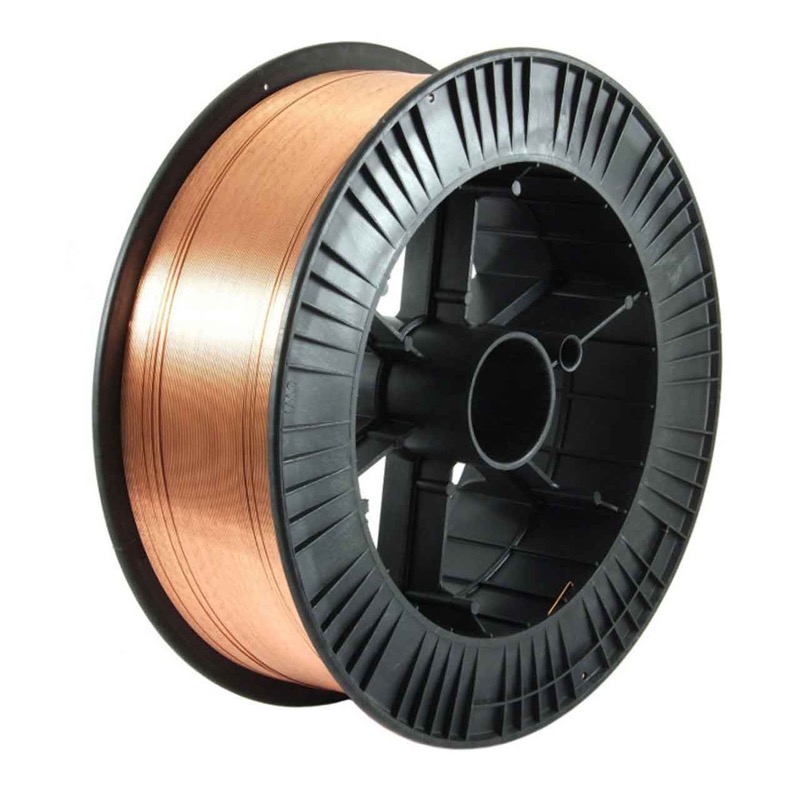
| Coating Type | copper-coated solid wire |
| Tensile Strength | 70,000 psi |
| Yield Strength | 58,000 psi |
| Elongation | 22% |
| Impact Toughness | 20 ft-lbs at -20°F |
| Base Metals | carbon steel, low-alloy steel |
| Shielding Gas | 75% Ar / 25% CO2, 90% Ar / 10% CO2, 95% Ar / 5% CO2, 100% CO2 |
| Gas Flow Rate | 25-50 CFH |
| Max Interpass Temp | 600°F |
| AWS Specification | AWS A5.18/A5.18M:2023 |
ER70S-6 Questions
What MIG wire for mild steel?
ER70S-6 is the default MIG wire for mild steel. It works on everything from sheet metal to heavy plate and handles lightly rusted or oily surfaces better than other carbon steel wires. Run it on DCEP with 75/25 argon/CO2 for the cleanest welds, or 100% CO2 for deeper penetration on thicker material. If your steel is very clean and you want less silicon residue on the bead, ER70S-3 is an alternative, but ER70S-6 is the right choice for 90% of mild steel MIG work. See also: ER70S-3 specifications, ER70S-3 vs ER70S-6 comparison.
What shielding gas for MIG welding steel?
75% argon / 25% CO2 (called 75/25 or C-25) for general purpose mild steel MIG welding. This mix gives a smooth arc, low spatter, and a clean bead appearance. Use 100% CO2 for deeper penetration on thicker material or when cost matters, but expect more spatter. Some shops use 90/10 argon/CO2 for thin or cosmetic work. Never use 100% argon on carbon steel, it causes poor wetting and an unstable arc (argon-only is for aluminum and stainless).
Can I MIG weld outdoors?
MIG welding requires shielding gas, and wind blows the gas away from the weld puddle. Even a 5 mph breeze can cause porosity. For outdoor work, you have three options: build a wind screen around the joint, switch to flux-core wire (E71T-11) that generates its own shielding, or switch to stick welding. If you must MIG outdoors, increase your gas flow rate slightly and work close to the puddle, but be aware that results will be inconsistent in any real wind. E71T-11 specifications, flux-core wire that needs no shielding gas, designed for outdoor and field work. See also: E71T-11 vs ER70S-6 comparison.
Where to Buy ER70S-6
As an Amazon Associate, GageRef earns from qualifying purchases. These are affiliate links.
Manufacturer Data Sheets
External links to standards bodies and manufacturers. These leave GageRef.
Reference data only. Verify all settings against manufacturer documentation and the applicable welding code before use. Amperage ranges are starting points that vary by position, fit-up, and material. Welding involves serious injury risks including burns, electric shock, fume exposure, and fire. This site does not replace proper training, certification, or employer safety procedures. See full terms of use.
Data sourced from AWS A5.18/A5.18M. Amperage ranges are approximate starting points. adjust based on position, fit-up, and material thickness. Always follow manufacturer recommendations and applicable codes.