E71T-11 Flux-Core Wire: Settings & No-Gas Welding Guide
Flux-core wire that needs no gas. Runs 30 to 225 amps on DCEN, rated for flat, horizontal, vertical up, overhead. Amperage chart by diameter below.
E71T-11 is the go-to flux-core wire for welding without gas. The flux inside the wire creates its own shielding, so you do not need a gas cylinder. That makes it the best option for outdoor work in wind, farm repairs, and any portable welding where hauling gas is impractical. The welds are not as clean as MIG with gas, and you have slag to chip, but the convenience is hard to beat.
What This Means in Practice
E71T-11 is the wire that lets you MIG weld without a gas bottle. The flux core generates its own shielding gas, which means you can weld outdoors in wind that would blow away the argon shield on solid MIG wire. The weld quality is good but not as clean as gas-shielded MIG. You will get more spatter and a slag layer that needs chipping. For outdoor field work, farm equipment, and portability, nothing else matches it.
What Amps for E71T-11?
| Diameter | Amperage Range |
|---|---|
| 0.030" (0.8 mm) | 30 - 130A |
| 0.035" (0.9 mm) | 40 - 175A |
| 0.045" (1.2 mm) | 75 - 225A |
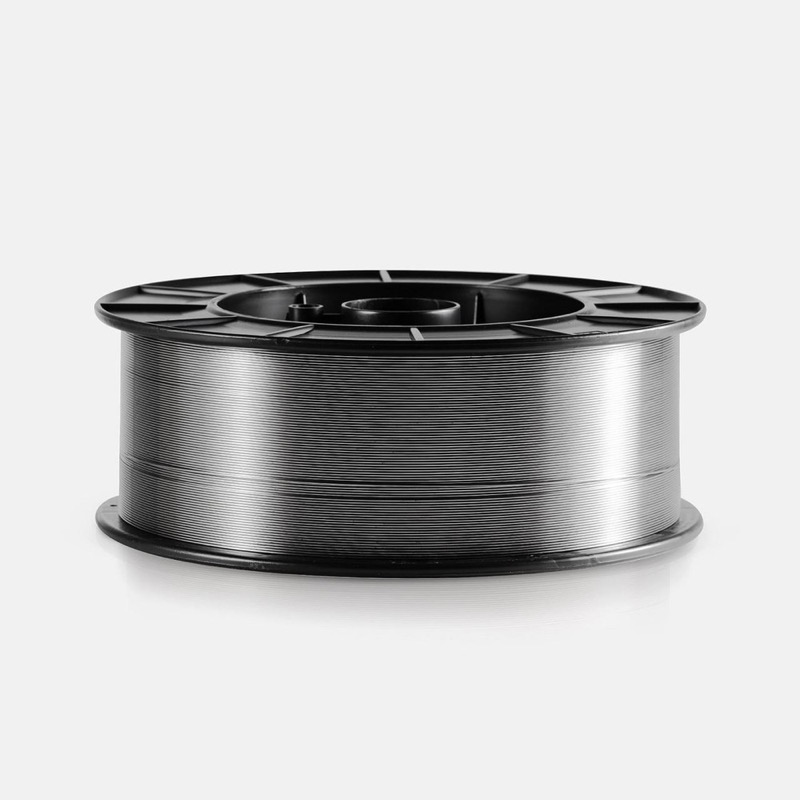
Amperage by Individual Diameter
0.030 E71T-11 Amperage
Set 0.030 E71T-11 to 30 - 130 amps. Run DCEN. This is the smallest available size. Best for vertical-up and overhead where you need a small, controllable puddle. Start around 80A.
0.035 E71T-11 Amperage
Set 0.035 E71T-11 to 40 - 175 amps. Run DCEN. This is the most commonly used E71T-11 size. Start at 108A for flat work, drop to 40-97A for vertical-up.
0.045 E71T-11 Amperage
Set 0.045 E71T-11 to 75 - 225 amps. Run DCEN. Largest available diameter. High deposition for flat and horizontal fillet welds on thick plate. Requires 75A minimum to run properly.
E71T-11 Suitability Scores
How well this electrode matches common applications. Not a quality rating. all AWS-certified electrodes meet their specification.
What Is E71T-11 Good For?
Outdoor welding where wind makes gas shielding unreliable.
Farm and ranch repairs.
General-purpose fabrication without gas.
Portability, no gas bottle, no regulator, just wire and power.
The go-to wire for field work with a wire-feed welder.
Where E71T-11 Falls Short
Higher spatter than gas-shielded processes.
Weld quality and appearance inferior to GMAW or gas-shielded FCAW.
Slag removal required between passes.
Not as strong in multi-pass as solid wire with gas (lower impact toughness).
How E71T-11 Lays Down
Arc Behavior
Buzzy, spattery arc that sounds like frying bacon in a hot pan. More noise than solid MIG wire. The flux core pops and crackles as it burns off. Visible sparks fly 6-12 inches from the puddle.
How to Move
Drag the gun at 15-45 degrees from vertical, pointing back into the puddle. Never push flux-core. Pushing traps slag in the weld. Travel speed is slower than solid MIG because the flux needs time to shield the puddle.
What the Puddle Does
Wider puddle than solid wire with a dark, crusty slag layer on top. The slag does not self-peel like E7018. You need a chipping hammer and wire brush between passes. The finished bead has coarse ripples under the slag.
Troubleshooting
If you see worm tracks (small tunnels in the bead surface), your voltage is too high or your travel speed is too fast. If the wire burns back into the tip, slow your wire feed speed. Start with the manufacturer mid-range settings and adjust from there.
Matching E71T-11 Diameter to Your Steel
| Wire Size | Material Thickness | Application |
|---|---|---|
| 0.030" | 1/16" to 3/16" | Light fabrication and auto body |
| 0.035" | 3/16" to 3/8" | General structural and farm repair |
| 0.045" | 3/8" and up | Heavy plate, multi-pass welds |
From the Field
E71T-11 is what you run when you want wire-feed speed without dragging a gas bottle into the field. It fills gaps that solid MIG wire cannot. Wind does not kill the arc because the flux provides its own shield. The trade-off is spatter. You will spend as much time cleaning up as welding if you do not dial your settings in. Keep your contact tip recessed 1/4 inch inside the nozzle and trim your stickout to 3/4 inch. These two adjustments cut spatter by half.
Bottom Line
E71T-11 earns its keep on repair jobs. It has no business on pipe applications. The closest alternative is E71T-GS.
Setup & Safety Reference
How to Store E71T-11
Store in dry area. Keep spool sealed. Flux-core wire is more moisture-sensitive than solid wire.
Preheat & Interpass Temperature for E71T-11
Preheat varies by base metal thickness. Non-low-hydrogen electrodes require higher preheat on thick material.
| Base Metal Thickness | Minimum Preheat (°F) |
|---|---|
| up to 3/4" | Not required |
| 3/4" to 1-1/2" | 150°F |
| 1-1/2" to 2-1/2" | 225°F |
| over 2-1/2" | 300°F |
Maximum interpass temperature: 600°F
Source: AWS D1.1 Table 3.2, Category A (non-low-hydrogen)
Wire Feed Speed for E71T-11
Self-shielded flux-core. No gas correction needed.
| Diameter | Amperage | Wire Feed Speed (IPM) |
|---|---|---|
| 0.030" | 30-70A | 80-200 IPM |
| 0.030" | 70-130A | 200-400 IPM |
| 0.035" | 40-100A | 80-220 IPM |
| 0.035" | 100-175A | 220-450 IPM |
| 0.045" | 75-130A | 70-180 IPM |
| 0.045" | 130-225A | 180-380 IPM |
Deposition Rates
| Diameter | Deposition Rate |
|---|---|
| 0.030" | 2-4 lbs/hr |
| 0.035" | 3-7 lbs/hr |
| 0.045" | 4-11 lbs/hr |
Fume Generation
Rating: High
Typical fume rate: 0.8-1.8 g/min
Self-shielded flux-core generates the highest fume of any wire process. Mandatory ventilation or extraction.
Common Brand Names for E71T-11
You will find E71T-11 sold under 4 brand names. Lincoln Electric Innershield NR-211-MP has the widest distribution.
| Manufacturer | Product Name | Notes |
|---|---|---|
| Lincoln Electric | Innershield NR-211-MP | Best-selling flux-core wire in North America |
| Hobart | Fabshield 21B | |
| ESAB | Coreshield 11 | |
| Forney | E71T-11 |
Full Specs
| Property | Value |
|---|---|
| AWS Classification | E71T-11 |
| Process | Flux-Core Welding (FCAW) |
| Polarity | DCEN |
| Positions | flat, horizontal, vertical up, overhead |
| Penetration | medium |
| Coating Type | self-shielded flux-cored |
| Tensile Strength | 70,000 psi |
| Yield Strength | 58,000 psi |
| Elongation | 22% |
| Impact Toughness | 20 ft-lbs at -20°F |
| Base Metals | carbon steel, low-carbon steel |
| Shielding Gas | Self-shielded (no external gas) |
| Max Interpass Temp | 600°F |
| AWS Specification | AWS A5.20/A5.20M:2021 |
Common Questions About E71T-11
Can I weld without shielding gas?
Yes, with self-shielded flux-core wire. E71T-11 has flux inside the wire that creates its own protective gas shield as it burns, so you do not need a gas bottle. This makes it the best option for outdoor work, field repairs, and portable welding where gas is impractical. You will have slag to chip, and the welds will not be as clean as gas-shielded MIG, but the convenience makes it the most popular wire for farm, ranch, and maintenance work. For indoor shop work where gas is available, ER70S-6 specifications (MIG wire with gas) produces cleaner welds. See also: E71T-11 vs ER70S-6 comparison.
Is flux core as strong as MIG?
E71T-11 flux-core wire has a minimum tensile strength of 70,000 psi, the same as ER70S-6 MIG wire. In controlled conditions with proper technique, both produce welds of comparable strength. The practical difference is that MIG with gas shielding produces a cleaner weld with less porosity risk, and the arc is smoother and easier to control. Flux-core tends to have more spatter and the beads are rougher, but when done correctly the mechanical properties are equivalent. See also: ER70S-6 specifications, E71T-11 vs ER70S-6 comparison.
What is the difference between flux core and MIG?
MIG (GMAW) uses solid wire with external shielding gas from a bottle. Flux-core (FCAW) uses tubular wire with flux inside that creates its own shielding. MIG produces cleaner welds with less spatter and no slag. Flux-core can weld outdoors in wind without gas, handles dirtier steel, and has higher deposition rates on thick material. Most small shop welders use MIG (ER70S-6 wire with 75/25 gas) for daily work and keep flux-core (E71T-11) for outdoor or field situations. See also: ER70S-6 specifications, E71T-11 vs ER70S-6 comparison.
Where to Buy E71T-11
As an Amazon Associate, GageRef earns from qualifying purchases. These are affiliate links.
Manufacturer Data Sheets
External links to standards bodies and manufacturers. These leave GageRef.
Reference data only. Verify all settings against manufacturer documentation and the applicable welding code before use. Amperage ranges are starting points that vary by position, fit-up, and material. Welding involves serious injury risks including burns, electric shock, fume exposure, and fire. This site does not replace proper training, certification, or employer safety procedures. See full terms of use.
Data sourced from AWS A5.20/A5.20M. Amperage ranges are approximate starting points. adjust based on position, fit-up, and material thickness. Always follow manufacturer recommendations and applicable codes.