
Male vs Female Hydraulic Fittings: How to Tell Them Apart and Measure Them
Last reviewed November 1, 2026. Sources are listed at the bottom of the page. Report a mistake on this page
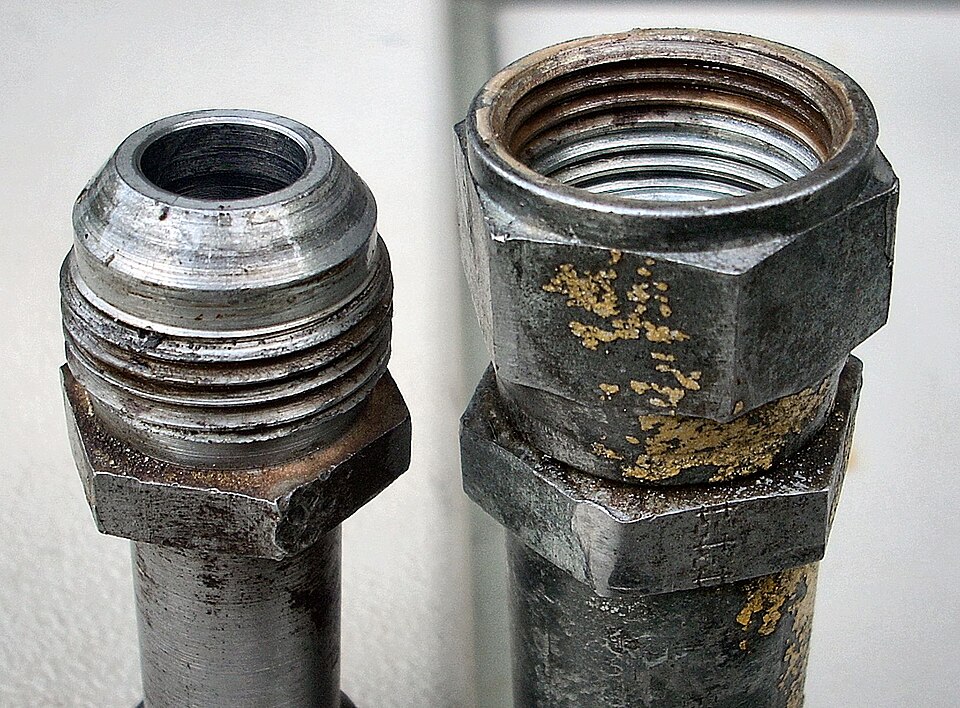
Every hydraulic connection pairs a male end with a female end of the same standard and size. A male end has its threads on the outside. A female end has its threads on the inside. Where the seal sits depends on the standard, and that is what you check before ordering a part.
Male and Female, Standard by Standard
The same dash or nominal size is used for both ends. A -8 JIC male mates with a -8 JIC female, and a 1/2 inch male NPT threads into a 1/2 inch female NPT.
| Standard | Male end | Female end | Where it seals |
|---|---|---|---|
| NPT / NPTF | External tapered thread (MNPT, MPT, MIP) | Internal tapered thread (FNPT, FPT, FIP) | On the threads; Parker calls for thread sealant even on NPTF |
| JIC 37° flare | External straight thread with a 37° cone on the nose | Swivel nut with internal thread; the 37° seat is inside | Metal-to-metal, cone against seat |
| SAE ORB | Straight-thread stud with an O-ring at the base of the thread | The port in the pump, valve, or manifold | O-ring in the port's tapered seat |
| ORFS | Straight thread with an O-ring in a groove on the flat face | Swivel nut holding a flat-faced sleeve or hose end | O-ring compressed by the flat face |
| BSPP | External parallel thread | Internal parallel thread, usually a port | Bonded washer or O-ring at a port; 60-degree cone on swivel hose ends |
Names like MNPT and FNPT only describe gender. See the NPT thread names guide for every abbreviation.
How to Measure Each End
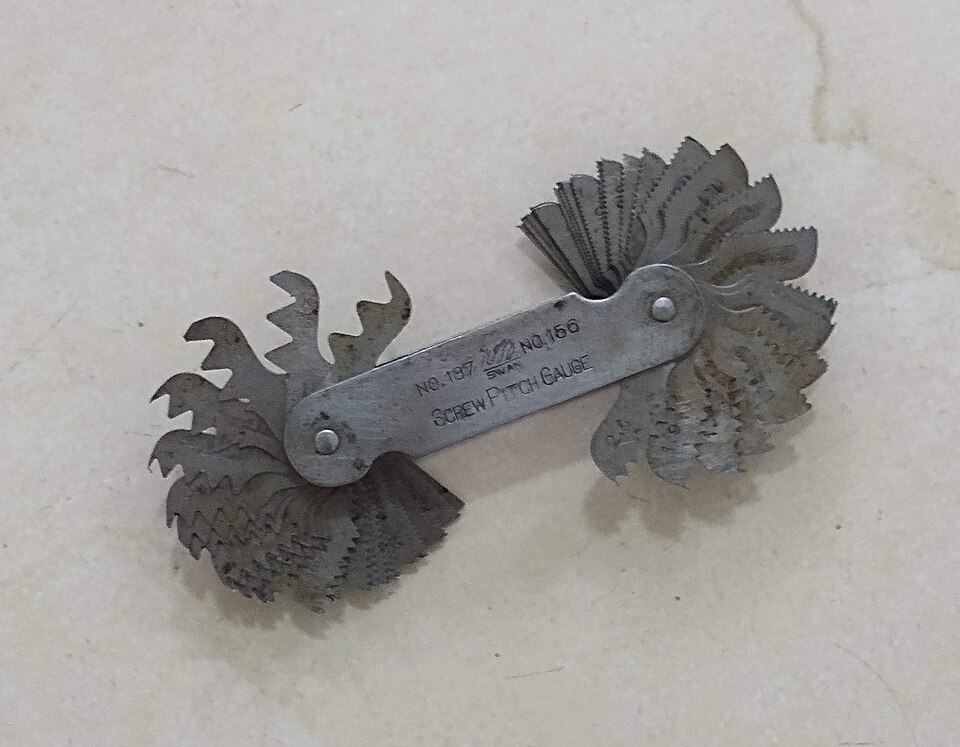
Brennan Industries' thread measuring guide uses three tools: calipers, a thread pitch gauge, and a seat angle gauge.
Male thread: measure the outside diameter across the thread crests with calipers. A male straight thread reads slightly under its nominal size.
Female thread: measure the inside diameter with the inside jaws of the calipers. It reads smaller than the nominal size, because the jaws touch the thread crests rather than the roots.
Pitch: try pitch gauge leaves until one fits snugly in the threads. Read threads per inch for inch threads, or millimeter pitch for metric.
Seat angle: on a male end, set the gauge against the sealing surface. On a female end, insert the gauge into the opening against the seat.
Tapered threads (NPT, BSPT) change diameter along their length, so the reading depends on where you measure.
Common Mistakes
Ordering by tube size alone. Dash size is the same for male and female, but you still need to say which end you have. A "-8 JIC" can be either.
Mixing up ORB and ORFS. Both use an O-ring. On SAE ORB the O-ring sits at the base of the male thread and seals against a port. On ORFS the O-ring sits in a groove on the flat face of the male end.
Matching threads but not seats. Two ends can share a thread and still not seal if the seats differ. Check the seat angle as well as the thread. The thread chart lists threads that appear in more than one standard.
Loosening a fitting under pressure. Relieve system pressure before you put a wrench on any fitting you are about to identify.
Source: Parker Hannifin Catalog 4300 v13 (8/2026), Section B (Triple-Lok tube end and swivel figures) and Section R (port, Triple-Lok, and Seal-Lok assembly); Brennan Industries, How to Measure Threads in Three Steps; ANSI/ASME B1.20.1. GageRef is an independent reference and sells no fittings.
Tools for This Job
Paid links: as an Amazon Associate, GageRef earns from qualifying purchases. These open Amazon search results, not a specific product we endorse.
- Digital caliper Measures male thread OD and female thread ID
- Thread pitch gauge (inch and metric) Reads threads per inch or millimeter pitch
- Hydraulic seat angle gauge Tells 37°, 45°, 30°, and 24° seats apart
- Hydraulic thread ID kit Pitch gauges, seat gauges, and calipers in one case
Male vs Female Hydraulic Fittings: Common Questions
How do I know if a hydraulic fitting is male or female?
A male fitting has its threads on the outside; a female fitting has its threads on the inside. On a JIC male end you will also see the 37-degree cone on the nose, and a JIC female is a swivel nut with the seat inside. An SAE ORB male is a stud with an O-ring at the base of the thread; the female is the port it screws into.
What do MNPT and FNPT mean?
MNPT is male National Pipe Taper and FNPT is female National Pipe Taper. They are the same NPT thread; the M and F only tell you which end has external and which has internal threads. MPT and MIP mean the same as MNPT, and FPT and FIP mean the same as FNPT.
How do you measure a female hydraulic thread?
Use the inside jaws of a caliper across the thread crests to get the inside diameter, then confirm the pitch with a thread pitch gauge. A female thread measures smaller than its nominal size because the caliper touches the crests. Check the seat by inserting a seat angle gauge into the opening.
Reference data only. Verify thread dimensions with a thread identification gauge before making connections. Working with pressurized hydraulic systems involves serious injury risks including high-pressure injection, burns, and crushing hazards.
Before loosening any fitting: shut the machine down, relieve all system pressure (including accumulators and pressure trapped in cylinders), and lower or block any raised load. Never feel for a leak with your hand; use a piece of cardboard. A pinhole jet of hydraulic fluid can inject under the skin, and an injection injury needs emergency medical care even if it looks minor.
This site does not replace manufacturer specifications, proper training, or employer safety procedures. See full terms of use.