
Hydraulic Hose vs Tube Dash Sizes: Why a -8 Hose and a -8 Tube Differ
Last reviewed November 1, 2026. Sources are listed at the bottom of the page. Report a mistake on this page
Hose and tube both use dash numbers in sixteenths of an inch, but they measure different things. Tube dash size is the tube's outside diameter. Hose dash size is the hose's inside diameter. So a -8 tube is 1/2 inch across the outside, while a -8 hose has a 1/2 inch bore. The fitting thread on each end follows the dash size, so a -8 hose and a -8 tube both typically end in a -8 fitting, such as a 3/4-16 JIC.
Dash Size to Hose ID and Tube OD
For standard hydraulic hose, divide the dash number by 16 to get the inside diameter in inches. For tube, the same arithmetic gives the outside diameter.
| Dash | Standard hose ID | Tube OD |
|---|---|---|
| -4 | 1/4 in | 1/4 in |
| -6 | 3/8 in | 3/8 in |
| -8 | 1/2 in | 1/2 in |
| -10 | 5/8 in | 5/8 in |
| -12 | 3/4 in | 3/4 in |
| -16 | 1 in | 1 in |
| -20 | 1-1/4 in | 1-1/4 in |
| -24 | 1-1/2 in | 1-1/2 in |
Because tube is sized by its outside diameter, its bore is smaller than the dash size by twice the wall thickness. A -8 hose has a larger bore than a -8 tube.
Exceptions: SAE 100R5 and Others
Brennan Industries lists hose types whose dash numbers do not equal the ID in sixteenths: SAE J51, SAE 100R5, SAE 100R14, and SAE J2064. For these, look up the actual ID in the manufacturer's data rather than dividing by 16.
| Dash | Actual ID (in) | Actual ID (mm) |
|---|---|---|
| -4 | 0.19 | 4.8 |
| -6 | 0.31 | 7.9 |
| -8 | 0.41 | 10.3 |
| -10 | 0.50 | 12.7 |
| -12 | 0.62 | 15.9 |
| -16 | 0.88 | 22.2 |
| -20 | 1.12 | 28.6 |
| -24 | 1.38 | 34.9 |
Values from Danfoss product pages for Aeroquip FC300 hose. Other brands of R5-type hose may differ; check the hose data sheet.
Choosing Hose Ends
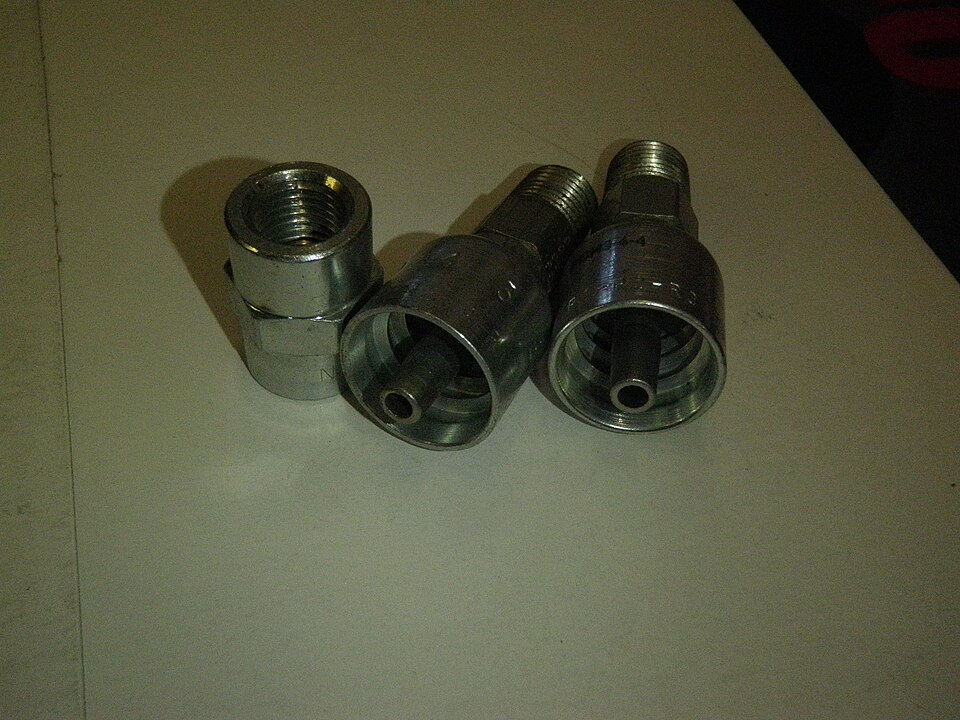
The hose end's dash size normally matches the hose. For example, Danfoss listed its Everflex SK-1308 female JIC swivel hose end (since discontinued) for -8 (1/2 inch ID) hose, with a 3/4-16 JIC thread. Matching the dash number is not enough on its own: manufacturers qualify each hose end for specific hose series, so use an end listed for the exact hose you have, and crimp it with that manufacturer's specified dies and settings.
Practical Tips
Measure hose ID, not OD. The outside diameter of hose changes with its construction (braid count, cover), so it does not tell you the dash size.
Read the layline. Most hydraulic hose is printed along its length with the manufacturer, hose type, and size, which is the quickest way to identify an existing hose.
Do not assume 100R5 follows the standard rule. If the layline says 100R5, use the actual IDs above.
Source: Brennan Industries, Considerations When Measuring Hydraulic Hose; Danfoss Power Solutions product pages for Aeroquip FC300 (SAE 100R5) hose, GH781-8 hose, and Everflex SK-1308 hose fitting; Parker Hannifin Catalog 4300 v13 Table R22 (tube OD by dash size). GageRef is an independent reference and sells no fittings.
Hydraulic Hose vs Tube Dash Sizes: Common Questions
Is hydraulic hose dash size the ID or the OD?
For standard hydraulic hose, the dash size is the inside diameter in sixteenths of an inch: a -8 hose has a 1/2 inch ID. Tube is the opposite; its dash size is the outside diameter. Some hose types are exceptions, including SAE 100R5, 100R14, J51, and J2064, so check the actual ID for those.
What is the ID of -8 100R5 hose?
About 0.41 inch (10.3 mm), per Danfoss's listing for Aeroquip FC300 hose (sold as R5). That is smaller than the 1/2 inch you would get by dividing 8 by 16, because 100R5 does not follow the standard hose dash rule.
Reference data only. Verify thread dimensions with a thread identification gauge before making connections. Working with pressurized hydraulic systems involves serious injury risks including high-pressure injection, burns, and crushing hazards.
Before loosening any fitting: shut the machine down, relieve all system pressure (including accumulators and pressure trapped in cylinders), and lower or block any raised load. Never feel for a leak with your hand; use a piece of cardboard. A pinhole jet of hydraulic fluid can inject under the skin, and an injection injury needs emergency medical care even if it looks minor.
This site does not replace manufacturer specifications, proper training, or employer safety procedures. See full terms of use.